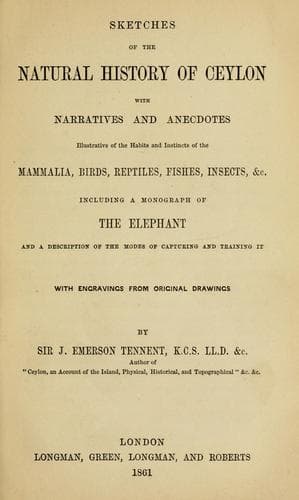
Sketches of the Natural History of CeylonTennent, James Emerson, Sir
Science
Sketches of the Natural History of Ceylon
Tennent, James Emerson, Sir
Animals -- Sri Lanka; Asiatic elephant -- Sri Lanka
Of the 72 who died in one year's servitude, 35 expired within the first
six months of their captivity. During training, many elephants die in
the unaccountable manner already referred to, of what the natives
designate _a broken heart_.
On being first subjected to work, the elephant is liable to severe and
often fatal swellings of the jaws and abdomen.[1]
[Footnote 1: The elephant which was dissected by DR. HARRISON of Dublin,
in 1847, died of a febrile attack, after four or five days' illness,
which, as Dr. H. tells me in a private letter, was "very like
scarlatina, at that time a prevailing disease; its skin in some places
became almost scarlet."]
From these causes there died, between 1841 and 1849 9
Of cattle murrain 10
Sore feet 1
Colds and inflammation 6
Diarrhoea 1
Worms 1
Of diseased liver 1
Injuries from a fall 1
General debility 1
Unknown causes 3
Of the entire, twenty-three were females and eleven males.
The ages of those that died could not be accurately stated, owing to the
circumstance of their having been captured in corral. Two only were
tuskers. Towards keeping the stud in health, nothing has been found so
conducive as regularly bathing the elephants, and giving them the
opportunity to stand with their feet in water, or in moistened earth.
Elephants are said to be afflicted with tooth-ache; their tushes have
likewise been found with symptoms of internal perforation by some
parasite, and the natives assert that, in their agony, the animals have
been known to break them off short.[1] I have never heard of the teeth
themselves being so affected, and it is just possible that the operation
of shedding the subsequent decay of the milk-tushes, may have in some
instances been accompanied by incidents that gave rise to this story.
[Footnote 1: See a paper entitled "_Recollections of Ceylon_," in
_Fraser's Magazine_ for December, 1860.]
At the same time the probabilities are in favour of its being true.
CUVIER committed himself to the statement that the tusks of the elephant
have no attachments to connect them with the pulp lodged in the cavity
at their base, from which the peculiar modification of dentine, known as
"ivory," is secreted[1]; and hence, by inference, that they would be
devoid of sensation.
[Footnote 1: _Annales du Muséum_ F. viii. 1805. p. 94, and _Ossemens
Fossiles_, quoted by OWEN, in the article on "Teeth," in TODD'S _Cyclop.
of Anatomy, &c_., vol. iv. p. 929.]
Public-domain text, read in full here on John Shaqi.
Reviews
Reviews
No reviews yet
Be the first to share your thoughts on this work.
Elsewhere in the archive
Join the Discussion
Join the discussion
Sign in to leave a comment or review.
Sign InorCreate an account