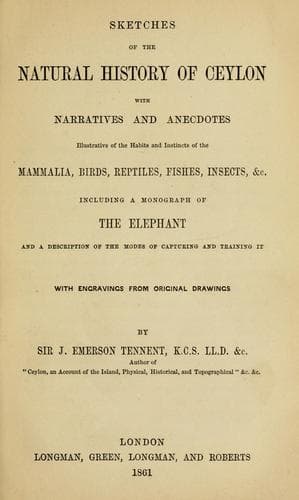
Sketches of the Natural History of CeylonTennent, James Emerson, Sir
Science
Sketches of the Natural History of Ceylon
Tennent, James Emerson, Sir
Animals -- Sri Lanka; Asiatic elephant -- Sri Lanka
But independently of the fact that ivory in permeated by tubes so fine
that at their origin from the pulpy cavity they do not exceed 1/15000th
part of an inch in diameter, OWEN had the tusk and pulp of the great
elephant which died at the Zoological Gardens in London in 1847
longitudinally divided, and found that, "although the pulp could be
easily detached from the inner surface of the cavity, it was not without
a certain resistance; and when the edges of the co-adapted pulp and tusk
were examined by a strong lens, the filamentary processes from the outer
surface of the former could be seen stretching, as they were drawn from
the dentinal tubes, before they broke. These filaments are so minute, he
adds, that to the naked eye the detached surface of the pulp seems to be
entire; and hence CUVIER was deceived into supposing that there was no
organic connexion between the pulp and the ivory. But if, as there seems
no reason to doubt, these delicate nervous processes traverse the tusk
by means of the numerous tubes already described, if attacked by caries
the pain occasioned to the elephant would be excruciating.
As to maintaining a stud of elephants for the purposes to which they are
now assigned in Ceylon, there may be a question on the score of prudence
and economy. In the rude and unopened parts of the country, where rivers
are to be forded, and forests are only traversed by jungle paths, their
labour is of value, in certain contingencies, in the conveyance of
stores, and in the earlier operations for the construction of fords and
rough bridges of timber. But in more highly civilised districts, and
wherever macadamised roads admit of the employment of horses and oxen
for draught, I apprehend that the services of elephants might, with
advantage, be gradually reduced, if not altogether dispensed with.
The love of the elephant for coolness and shade renders him at all times
more or less impatient of work in the sun, and every moment of leisure
he can snatch is employed in covering his back with dust, or fanning
himself to diminish the annoyance of the insects and heat. From the
tenderness of his skin and its liability to sores, the labour in which
he can most advantageously be employed is that of draught; but the
reluctance of horses to meet or pass elephants renders it difficult to
work the latter with safety on frequented roads. Besides, were the full
load which an elephant is capable of drawing, in proportion to his
muscular strength, to be placed upon waggons of corresponding dimension,
the to the roads would be such that the wear and tear of the highways
and bridges would prove too costly to be borne. On the other hand, by
restricting it to a somewhat more manageable quantity, and by limiting
the weight, as at present, to about _one ton and a half_, it is doubtful
whether an elephant performs so much more work than could be done by a
horse or by bullocks, as to compensate for the greater cost of his
feeding and attendance.
Public-domain text, read in full here on John Shaqi.
Reviews
Reviews
No reviews yet
Be the first to share your thoughts on this work.
Elsewhere in the archive
Join the Discussion
Join the discussion
Sign in to leave a comment or review.
Sign InorCreate an account