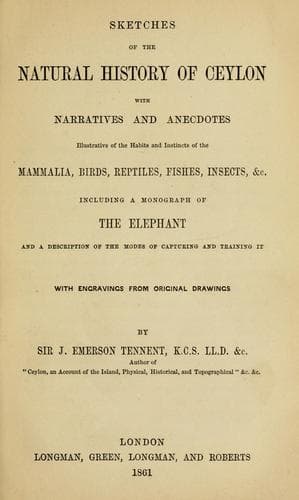
Sketches of the Natural History of CeylonTennent, James Emerson, Sir
Science
Sketches of the Natural History of Ceylon
Tennent, James Emerson, Sir
Animals -- Sri Lanka; Asiatic elephant -- Sri Lanka
Add to this, that from accidents and other causes, from ulcerations of
the skin, and illnesses of many kinds, the elephant is so often
invalided, that the actual cost of his labour, when at work, is very
considerably enhanced. Exclusive of the salaries of higher officers
attached to the government establishments, and other permanent charges,
the expenses of an elephant, looking only to the wages of his attendants
and the cost of his food and medicines, varies from _three shillings to
four shillings and sixpence_, per diem, according to his size and
class.[1] Taking the average at three shillings and nine-pence, and
calculating that hardly any individual works more than four days out of
seven, the charge for each day so employed would amount to _six
shillings and sixpence_. The keep per day of a powerful dray-horse,
working five days in the week, would not exceed half-a-crown, and two
such would unquestionably do more work than any elephant under the
present system. I do not know whether it be from a comparative
calculation of this kind that the strength of the elephant
establishments in Ceylon has been gradually diminished of late years,
but in the department of the Commissioner of Roads, the stud, which
formerly numbered upwards of sixty elephants, was reduced, some years
ago, to thirty-six, and is at present less than half that number.
[Footnote 1: An ordinary-sized elephant engrosses the undivided
attention of _three_ men. One, as his mahout or superintendent, and two
as leaf-cutters, who bring him branches and grass for his daily
supplies. An animal of larger growth would probably require a third
leaf-cutter. The daily consumption is two cwt. of green food with about
half a bushel of grain. When in the vicinity of towns and villages, the
attendants have no difficulty in procuring an abundant supply of the
branches of the trees to which elephants are partial; and in journeys
through the forests and unopened country, the leaf-cutters are
sufficiently expert in the knowledge of those particular plants with
which the elephant is satisfied. Those that would be likely to disagree
with him he unerringly rejects. His favourites are the palms, especially
the cluster of rich, unopened leaves, known as the "cabbage," of the
coco-nut, and areca; and he delights to tear open the young trunks of
the palmyra and jaggery (_Caryota urens_) in search of the farinaceous
matter contained in the spongy pith. Next to these come the varieties of
fig-trees. particularly the sacred _Bo_ (_F. religiosa_) which is found
near every temple, and the _na gaha_ (_Messua ferrea_), with thick dark
leaves and a scarlet flower. The leaves of the Jak-tree and bread-fruit
(_Artocarpus integrifolia_, and _A. incisa_), the Wood apple (_Ægle
Marmelos_), Palu (_Mimusops Indica_), and a number of others well known
to their attendants, are all consumed in turn. The stems of the
plaintain, the stalks of the sugar-cane, and the feathery tops of the
bamboos, are irresistible luxuries.
Public-domain text, read in full here on John Shaqi.
Reviews
Reviews
No reviews yet
Be the first to share your thoughts on this work.
Elsewhere in the archive
Join the Discussion
Join the discussion
Sign in to leave a comment or review.
Sign InorCreate an account