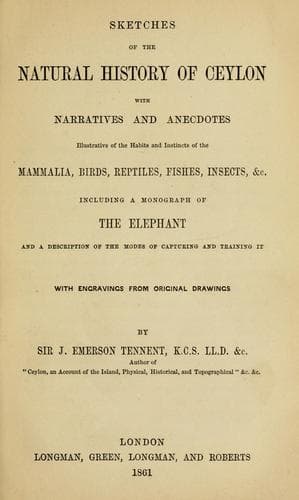
Sketches of the Natural History of CeylonTennent, James Emerson, Sir
Science
Sketches of the Natural History of Ceylon
Tennent, James Emerson, Sir
Animals -- Sri Lanka; Asiatic elephant -- Sri Lanka
The duration of life in the elephant has been from the remotest times a
matter of uncertainty and speculation. Aristotle says it was reputed to
live from two to three hundred years[1], and modern zoologists have
assigned to it an age very little less; CUVIER[2] allots two hundred and
DE BLAINVILLE one hundred and twenty. The only attempt which I know of
to establish a period historically or physiologically is that of
FLEURENS, who has advanced an ingenious theory on the subject in his
treatise "_De la Longévité Humaine_." He assumes the sum total of life
in all animals to be equivalent to five times the number of years
requisite to perfect their growth and development;--and he adopts as
evidence of the period at which growth ceases, the final consolidation
of the bones with their _epiphyses_; which in the young consist of
cartilages; but in the adult become uniformly osseous and solid. So long
as the epiphyses are distinct from the bones, the growth of the animal
is proceeding, but it ceases so soon as the consolidation is complete.
In man, according to FLEURENS, this consummation takes place at 20 years
of age, in the horse at 5, in the dog at 2; so that conformably to this
theory the respective normal age for each would be 100 years for man, 25
for the horse, and 10 for a dog. As a datum for his conclusion, FLEURENS
cites the instance of one young elephant in which, at 26 years old, the
epiphyses were still distinct, whereas in another, which died at 31,
they were firm and adherent. Hence he draws the inference that the
period of completed solidification is thirty years, and consequently
that the normal age of the elephant is _one hundred and fifty_.[3]
[Footnote 1: ARISTOTELES _de Anim. l. viii._ c. 9.]
[Footnote 2: _Menag. de Mus. Nat._ p. 107.]
[Footnote 3: FLEURENS, _De la Longévité Humaine_, pp. 82, 89.]
Public-domain text, read in full here on John Shaqi.
Reviews
Reviews
No reviews yet
Be the first to share your thoughts on this work.
Elsewhere in the archive
Join the Discussion
Join the discussion
Sign in to leave a comment or review.
Sign InorCreate an account