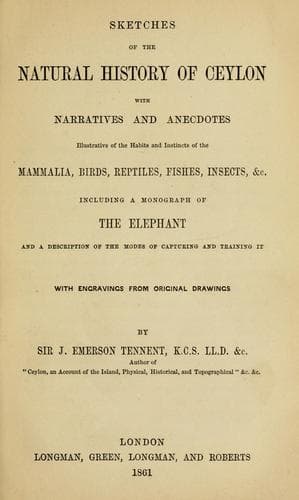
Sketches of the Natural History of CeylonTennent, James Emerson, Sir
Science
Sketches of the Natural History of Ceylon
Tennent, James Emerson, Sir
Animals -- Sri Lanka; Asiatic elephant -- Sri Lanka
Amongst the Singhalese the ancient fable of the elephant attaining to
the age of two or three hundred years still prevails; but the Europeans,
and those in immediate charge of tame ones, entertain the opinion that
the duration of life for about _seventy_ years is common both to man and
the elephant; and that before the arrival of the latter period, symptoms
of debility and decay ordinarily begin to manifest themselves. Still
instances are not wanting in Ceylon of trained decoys that have lived
for more than double the reputed period in actual servitude. One
employed by Mr. Cripps in the Seven Korles was represented by the
Cooroowe people to have served the king of Kandy in the same capacity
sixty years before; and amongst the papers left by Colonel Robertson
(son to the historian of "Charles V."), who held a command in Ceylon in
1799, shortly after the capture of the island by the British, I have
found a memorandum showing that a decoy was then attached to the
elephant establishment at Matura, which the records proved to have
served under the Dutch during the entire period of their occupation
(extending to upwards of one hundred and forty years); and it was said
to have been found in the stables by the Dutch on the expulsion of the
Portugese in 1656.
It is perhaps from this popular belief in their almost illimitable age,
that the natives generally assert that the body of a dead elephant is
seldom or never to be discovered in the woods. And certain it is that
frequenters of the forest with whom I have conversed, whether European
or Singhalese, are consistent in their assurances that they have never
found the remains of an elephant that had died a natural death. One
chief, the Wannyah of the Trincomalie district, told a friend of mine,
that once after a severe murrain, which had swept the province, he found
the carcases of elephants that had died of the disease. On the other
hand, a European gentleman, who for thirty-six years without
intermission has been living in the jungle, ascending to the summits of
mountains in the prosecution of the trigonometrical survey, and
penetrating valleys in tracing roads and opening means of
communication,--one, too, who has made the habits of the wild elephant a
subject of constant observation and study,--has often expressed to me
his astonishment that after seeing many thousands of living elephants in
all possible situations, he had never yet found a single skeleton of a
dead one, except of those which had fallen by the rifle.[1]
[Footnote 1: This remark regarding the elephant of Ceylon does not
appear to extend to that of Africa, as I observe that BEAVER, in his
_African Memoranda,_ says that "the skeletons of old ones that have died
in the woods are frequently found."--_African Memoranda relative to an
attempt to establish British Settlements at the Island of Bulama_. Lond.
1815, p. 353.]
Public-domain text, read in full here on John Shaqi.
Reviews
Reviews
No reviews yet
Be the first to share your thoughts on this work.
Elsewhere in the archive
Join the Discussion
Join the discussion
Sign in to leave a comment or review.
Sign InorCreate an account