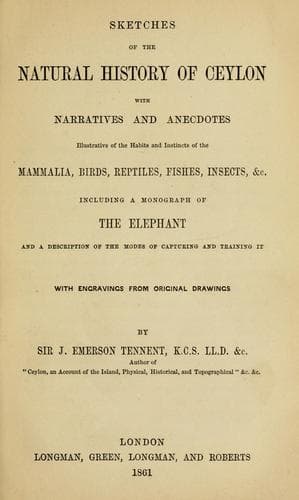
Sketches of the Natural History of CeylonTennent, James Emerson, Sir
Science
Sketches of the Natural History of Ceylon
Tennent, James Emerson, Sir
Animals -- Sri Lanka; Asiatic elephant -- Sri Lanka
[Footnote 3: See a disquisition on the origin of the story of Sinbad, by
M. REINAUD, in the introduction prefixed to his translation of the
_Arabian Geography of Aboulfeda_, vol. i. p. lxxvi.]
* * * * *
APPENDIX TO CHAPTER VII.
* * * * *
As Ælian's work on the _Nature of Animals_ has never, I believe, been
republished in any English version, and the passage in relation to the
training and performance of elephants is so pertinent to the present
inquiry, I venture to subjoin a translation of the 11th Chapter of his
2nd Book.
"Of the cleverness of the elephant I have spoken elsewhere, and likewise
of the manner of hunting. I have mentioned these things, a few out of
the many which others have stated; but for the present I purpose to
speak of their musical feeling, their tractability, and facility in
learning what it is difficult for even a human being to acquire, much
less a beast, hitherto so wild:--such as to dance, as is done on the
stage; to walk with a measured gait; to listen to the melody of the
flute and to perceive the difference of sounds, that, being pitched low
lead to a slow movement, or high to a quick one: all this the elephant
learns and understands, and is accurate withal, and makes no mistake.
Thus has Nature formed him not only the greatest in size, but the most
gentle and the most easily taught. Now if I were going to write about
the tractability and aptitude to learn amongst those of India, Æthiopia,
and Libya, I should probably appear to be concocting a tale and acting
the braggart, or to be telling a falsehood respecting the nature of the
animal founded on a mere report, all which it behoves a philosopher, and
most of all one who is an ardent lover of truth, not to do. But what I
have seen myself, and what others have described as having occurred at
Rome, this I have chosen to relate, selecting a few facts out of many,
to show the particular nature of those creatures. The elephant when
tamed is an animal most gentle and most easily led to do whatever he is
directed. And by way of showing honour to time, I will first narrate
events of the oldest date. Cæsar Germanicus, the nephew of Tiberius,
exhibited once a public show, wherein there were many full-grown
elephants, male and female, and some of their breed born in this
country. When their limbs were beginning to become firm, a person
familiar with such animals instructed them by a strange and surpassing
method of teaching; using only gentleness and kindness, and adding to
his mild lessons the bait of pleasant and varied food. By this means he
led them by degrees to throw off all wildness, and, as it were, to
desert to a state of civilisation, conducting themselves in a manner
almost human. He taught them neither to be excited on hearing the pipe,
nor to be disturbed by the beat of drum, but to be soothed by the sounds
of the reed, and to endure unmusical noises and the clatter of feet from
Public-domain text, read in full here on John Shaqi.
Reviews
Reviews
No reviews yet
Be the first to share your thoughts on this work.
Elsewhere in the archive
Join the Discussion
Join the discussion
Sign in to leave a comment or review.
Sign InorCreate an account