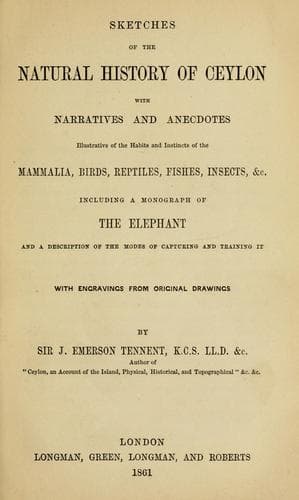
Sketches of the Natural History of CeylonTennent, James Emerson, Sir
Science
Sketches of the Natural History of Ceylon
Tennent, James Emerson, Sir
Animals -- Sri Lanka; Asiatic elephant -- Sri Lanka
The Singhalese have a further superstition in relation to the close of
life in the elephant: they believe that, on feeling the approach of
dissolution, he repairs to a solitary valley, and there resigns himself
to death. A native who accompanied Mr. Cripps, when hunting, in the
forests of Anarajapoora, intimated to him that he was then in the
immediate vicinity of the spot "_to which the elephants come to die_,"
but that it was so mysteriously concealed, that although every one
believed in its existence, no one had ever succeeded in penetrating to
it. At the corral which I have described at Kornegalle, in 1847,
Dehigame, one of the Kandyan chiefs, assured me it was the universal
belief of his countrymen, that the elephants, when about to die,
resorted to a valley in Saffragam, among the mountains to the east of
Adam's Peak, which was reached by a narrow pass with walls of rock on
either side, and that there, by the side of a lake of clear water, they
took their last repose.[1] It was not without interest that I afterwards
recognised this tradition in the story of _Sinbad of the Sea_, who in
his Seventh Voyage, after conveying the presents of Haroun al Raschid to
the king of Serendib, is wrecked on his return from Ceylon, and sold as
a slave to a master who employs him in shooting elephants for the sake
of their ivory; till one day the tree on which he was stationed having
been uprooted by one of the herd, he fell senseless to the ground, and
the great elephant approaching wound his trunk around him and carried
him away, ceasing not to proceed, until he had taken him to a place
where, his terror having subsided, _he found himself amongst the bones
of elephants, and knew that this was their burial place_.[2] It is
curious to find this legend of Ceylon in what has, not inaptly, been
described as the "Arabian Odyssey" of Sinbad; the original of which
evidently embodies the romantic recitals of the sailors returning from
the navigation of the Indian Seas, in the middle ages[3], which were
current amongst the Mussulmans, and are reproduced in various forms
throughout the tales of the _Arabian Nights_.
[Footnote 1: The selection by animals of a _place to die_, is not
confined to the elephant, DARWIN says, that in South America "the
guanacos (llamas) appear to have favourite spots for lying down to die;
on the banks of the Santa Cruz river, in certain circumscribed spaces
which were generally bushy and all near the water, the ground was
actually white with their bones; on one such spot I counted between ten
and twenty heads."--_Nat. Voy._ ch. viii. The same has been remarked in
the Rio Gallegos; and at St. Jago in the Cape de Verde Islands, DARWIN
saw a retired corner similarly covered with the bones of the goat, as if
it were "the burial-ground of all the goats in the island."]
[Footnote 2: _Arabian Nights' Entertainment_, LANE'S edition, vol. iii.
p. 77.]
Public-domain text, read in full here on John Shaqi.
Reviews
Reviews
No reviews yet
Be the first to share your thoughts on this work.
Elsewhere in the archive
Join the Discussion
Join the discussion
Sign in to leave a comment or review.
Sign InorCreate an account