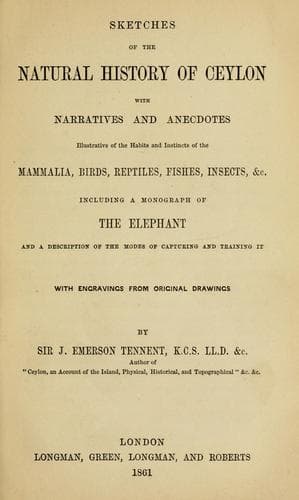
Sketches of the Natural History of CeylonTennent, James Emerson, Sir
Science
Sketches of the Natural History of Ceylon
Tennent, James Emerson, Sir
Animals -- Sri Lanka; Asiatic elephant -- Sri Lanka
Mr. Mitford, of the Ceylon Civil Service, to whom I am indebted for many
valuable notes relative to the birds of the island, regards the
identification of the Singhalese Devil-Bird as open to similar doubt: he
says--"The Devil-Bird is not an owl. I never heard it until I came to
Kornegalle, where it haunts the rocky hill at the back of
Government-house. Its ordinary note is a magnificent clear shout like
that of a human being, and which can be heard at a great distance, and
has a fine effect in the silence of the closing night. It has another
cry like that of a hen just caught, but the sounds which have earned for
it its bad name, and which I have heard but once to perfection, are
indescribable, the most appalling that can be imagined, and scarcely to
be heard without shuddering; I can only compare it to a boy in torture,
whose screams are being stopped by being strangled. I have offered
rewards for a specimen, but without success. The only European who had
seen and fired at one agreed with the natives that it is of the size of
a pigeon, with a long tail. I believe it is a Podargus or Night Hawk."
In a subsequent note he further says--"I have since seen two birds by
moonlight, one of the size and shape of a cuckoo, the other a large
black bird, which I imagine to be the one which gives these calls."]
II. PASSERES. _Swallows_.--Within thirty-five miles of Caltura, on the
western coast, are inland caves, to which the Esculent Swift[1] resorts,
and there builds the "edible bird's nest," so highly prized in China.
Near the spot a few Chinese immigrants have established themselves, who
rent the nests as a royalty from the government, and make an annual
export of the produce. But the Swifts are not confined to this district,
and caves containing them have been found far in the interior, a fact
which complicates the still unexplained mystery of the composition of
their nest; and, notwithstanding the power of wing possessed by these
birds, adds something to the difficulty of believing that it consists of
glutinous material obtained from algæ.[2] In the nests brought to me
there was no trace of organisation; and the original material, whatever
it be, is so elaborated by the swallow as to present somewhat the
appearance and consistency of strings of isinglass. The quantity of
these nests exported from Ceylon is trifling.
[Footnote 1: Collocalia brevirostris, _McClell_.; C. nidifica, _Gray_.]
[Footnote 2: An epitome of what has been written on this subject will be
found in _Dr. Horsfield's Catalogue_ of the Birds in the E.I. Comp.
Museum, vol. i. p. 101, &c. Mr. Morris assures me, that he has found the
nests of the Esculent Swallow eighty miles distant from the sea.]
Public-domain text, read in full here on John Shaqi.
Reviews
Reviews
No reviews yet
Be the first to share your thoughts on this work.
Elsewhere in the archive
Join the Discussion
Join the discussion
Sign in to leave a comment or review.
Sign InorCreate an account