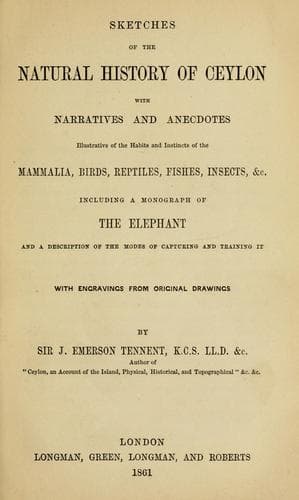
Sketches of the Natural History of CeylonTennent, James Emerson, Sir
Science
Sketches of the Natural History of Ceylon
Tennent, James Emerson, Sir
Animals -- Sri Lanka; Asiatic elephant -- Sri Lanka
_Kingfishers_.--In solitary places, where no sound breaks the silence
except the gurgle of the river as it sweeps round the rocks, the lonely
Kingfisher, the emblem of vigilance and patience, sits upon an
overhanging branch, his turquoise plumage hardly less intense in its
lustre than the deep blue of the sky above him; and so intent is his
watch upon the passing fish that intrusion fails to scare him from his
post.
_Sun Birds_.--In the gardens the tiny Sun Birds[1] (known as the Humming
Birds of Ceylon) hover all day long, attracted to the plants, over which
they hang poised on their glittering wings, and inserting their curved
beaks to extract the insects that nestle in the flowers.
[Footnote 1: Nectarina Zeylanica, _Linn._]
Perhaps the most graceful of the birds of Ceylon in form and motions,
and the most chaste in colouring, is the one which Europeans call "the
Bird of Paradise,"[1] and natives "the Cotton Thief," from the
circumstance that its tail consists of two long white feathers, which
stream behind it as it flies. Mr. Layard says:--"I have often watched
them, when seeking their insect prey, turn suddenly on their perch and
_whisk their long tails with a jerk_ over the bough, as if to protect
them from injury."
[Footnote 1: Tchitrea paradisi, _Linn._]
[Illustration: TCHITREA PARADISI.]
The tail is sometimes brown, and the natives have the idea that the bird
changes its plumage at stated periods, and that the tail-feathers become
white and brown in alternate years. The fact of the variety of plumage
is no doubt true, but this story as to the alternation of colours in the
same individual requires confirmation.[1]
[Footnote 1: The engraving of the Tchitrea given on page 244 is copied
by permission from one of the splendid drawings in. MR. GOULD'S _Birds
of India_.]
_The Bulbul_.--The _Condatchee Bulbul_[1], which, from the crest on its
head, is called by the Singhalese the "Konda Cooroola," or _Tuft bird_,
is regarded by the natives as the most "_game_" of all birds; and
training it to fight was one of the duties entrusted by the Kings of
Kandy to the Cooroowa, or Head-man, who had charge of the King's animals
and Birds. For this purpose the Bulbul is taken from the nest as soon as
the sex is distinguishable by the tufted crown; and secured by a string,
is taught to fly from hand to hand of its keeper. When pitted against an
antagonist, such is the obstinate courage of this little creature that
it will sink from exhaustion rather than release its hold. This
propensity, and the ordinary character of its notes, render it
impossible that the Bulbul of India could be identical with the Bulbul
of Iran, the "Bird of a Thousand Songs,"[2] of which, poets say that its
delicate passion for the rose gives a plaintive character to its note.
[Footnote 1: Pycnonotus hæmorrhous, _Gmel_.]
Public-domain text, read in full here on John Shaqi.
Reviews
Reviews
No reviews yet
Be the first to share your thoughts on this work.
Elsewhere in the archive
Join the Discussion
Join the discussion
Sign in to leave a comment or review.
Sign InorCreate an account