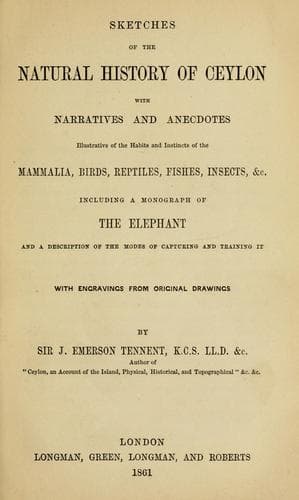
Sketches of the Natural History of CeylonTennent, James Emerson, Sir
Science
Sketches of the Natural History of Ceylon
Tennent, James Emerson, Sir
Animals -- Sri Lanka; Asiatic elephant -- Sri Lanka
One of these ingenious marauders, after vainly attitudinising in front
of a chained watch-dog, that was lazily gnawing a bone, and after
fruitlessly endeavouring to divert his attention by dancing before him,
with head awry and eye askance, at length flew away for a moment, and
returned bringing a companion which perched itself on a branch a few
yards in the rear. The crow's grimaces were now actively renewed, but
with no better success, till its confederate, poising itself on its
wings, descended with the utmost velocity, striking the dog upon the
spine with all the force of its strong beak. The _ruse_ was successful;
the dog started with surprise and pain, but not quickly enough to seize
his assailant, whilst the bone he had been gnawing was snatched away by
the first crow the instant his head was turned. Two well-authenticated
instances of the recurrence of this device came within my knowledge at
Colombo, and attest the sagacity and powers of communication and
combination possessed by these astute and courageous birds.
On the approach of evening the crows near Colombo assemble in noisy
groups along the margin of the freshwater lake which surrounds the fort
on the eastern side; and here for an hour or two they enjoy the luxury
of throwing the water over their shining backs, and arranging their
plumage decorously, after which they disperse, each taking the direction
of his accustomed quarters for the night.[1]
[Footnote 1: A similar habit has been noticed in the damask Parrots of
Africa (_Palæornis fuscus_) which daily resort at the same hour to their
accustomed pools to bathe.]
During the storms which usher in the monsoon, it has been observed, that
when coco-nut palms are destroyed by lightning, the effect frequently
extends beyond a single tree, and from the contiguity and conduction of
the spreading leaves, or some other peculiar cause, large groups will be
affected by a single flash, a few killed instantly, and the rest doomed
to rapid decay. In Belligam Bay, a little to the east of Point-de-Galle,
a small island, which is covered with coco-nuts, has acquired the name
of "Crow Island," from being the resort of those birds, which are seen
hastening towards it in thousands towards sunset. A few years ago,
during a violent storm of thunder, such was the destruction of the crows
that the beach for some distance was covered with a black line of their
remains, and the grove on which they had been resting was to a great
extent destroyed by the same flash.[1]
[Footnote 1: Similar instances are recorded in other countries of sudden
and prodigious mortality amongst crows; but whether occasioned by
lightning seems uncertain. In 1839 thirty-three thousand dead crows were
found on the shores of a lake in the county Westmeath in Ireland after a
storm.--THOMPSON'S _Nat. Hist. Ireland_, vol. i. p. 319. PATTERSON in
his _Zoology_, p. 356, mentions other cases.]
Public-domain text, read in full here on John Shaqi.
Reviews
Reviews
No reviews yet
Be the first to share your thoughts on this work.
Elsewhere in the archive
Join the Discussion
Join the discussion
Sign in to leave a comment or review.
Sign InorCreate an account