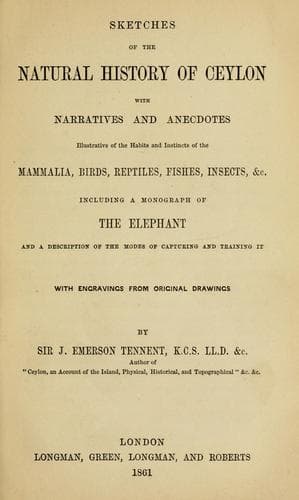
Sketches of the Natural History of CeylonTennent, James Emerson, Sir
Science
Sketches of the Natural History of Ceylon
Tennent, James Emerson, Sir
Animals -- Sri Lanka; Asiatic elephant -- Sri Lanka
III. SCANSORES. _Parroquets_.--Of the Psittacidæ the only examples are
the parroquets, of which the most renowned is the _Palæornis Alexandri_,
which has the historic distinction of bearing the name of the great
conqueror of India, having been the first of its race introduced to the
knowledge of Europe on the return of his expedition. An idea of their
number may be formed from the following statement of Mr. Layard, as to
the multitudes which are to be found on the western coast. "At Chilaw, I
have seen such vast flights of parroquets hurrying towards the coco-nut
trees which overhang the bazaar, that their noise drowned the Babel of
tongues bargaining for the evening provisions. Hearing of the swarms
that resorted to this spot, I posted myself on a bridge some half mile
distant, and attempted to count the flocks which came from a single
direction to the eastward. About four o'clock in the afternoon,
straggling parties began to wend towards home, and in the course of half
an hour the current fairly set in. But I soon found that I had no longer
distinct flocks to count, it became one living screaming stream. Some
flew high in the air till right above their homes, and dived abruptly
downward with many evolutions till on a level with the trees; others
kept along the ground and dashed close by my face with the rapidity of
thought, their brilliant plumage shining with an exquisite lustre in the
sun-light. I waited on the spot till the evening closed, when I could
hear, though no longer distinguish, the birds fighting for their
perches, and on firing a shot they rose with a noise like the 'rushing
of a mighty wind,' but soon settled again, and such a din commenced as I
shall never forget; the shrill screams of the birds, the fluttering of
their innumerable wings, and the rustling of the leaves of the palm
trees was almost deafening, and I was glad at last to escape to the
Government Rest House."[1]
[Footnote 1: _Annals of Nat. Hist._ vol. xiii. p. 263.]
IV. COLUMBIDÆ. _Pigeons_.--Of pigeons and doves there are at least a
dozen species. Some live entirely on trees[1], never alighting on the
ground; others, notwithstanding the abundance of food and warmth, are
migratory[2], allured, as the Singhalese allege, by the ripening of the
cinnamon berries, and hence one species is known in the southern
provinces as the "Cinnamon Dove." Others feed on the fruits of the
banyan: and it is probably to their instrumentality that this marvellous
tree chiefly owes its diffusion, its seeds being carried by them to
remote localities. A very beautiful pigeon, peculiar to the mountain
range, discovered in the lofty trees at Neuera-ellia, has, in compliment
to the Viscountess Torrington, been named _Carpophaga Torringtoniæ_.
[Footnote 1: Treron bicincta. _Jerd_.]
[Footnote 2: _Alsocomus puniceus_, the "Season Pigeon" of Ceylon, so
called from its periodical arrival and departure.]
Public-domain text, read in full here on John Shaqi.
Reviews
Reviews
No reviews yet
Be the first to share your thoughts on this work.
Elsewhere in the archive
Join the Discussion
Join the discussion
Sign in to leave a comment or review.
Sign InorCreate an account