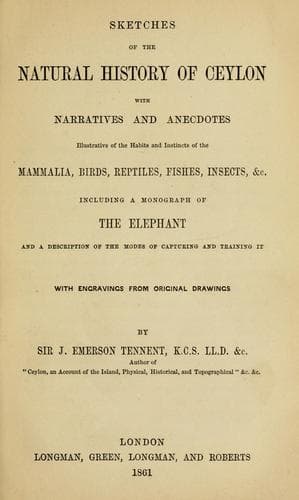
Sketches of the Natural History of CeylonTennent, James Emerson, Sir
Science
Sketches of the Natural History of Ceylon
Tennent, James Emerson, Sir
Animals -- Sri Lanka; Asiatic elephant -- Sri Lanka
_Blood-suckers_.--The lizards already mentioned, however, are but the
stranger's introduction to innumerable varieties of others, all most
attractive in their sudden movements, and some unsurpassed in the
brilliancy of their colouring, which bask on banks, dart over rocks, and
peer curiously out of the chinks of every ruined wall. In all their
motions there is that vivid and brief energy, the rapid but restrained
action associated with their limited power of respiration, which
justifies the accurate picture of--
"The green lizard, rustling thro' the grass,
And up the fluted shaft, _with short, quick, spring_
To vanish in the chinks which time has made."[1]
[Footnote 1: ROGERS' _Pæstum._]
The most beautiful of the race is the _green calotes_[1], in length
about twelve inches, which, with the exception of a few dark streaks
about the head, is as brilliant as the purest emerald or malachite.
Unlike its congeners of the same family, it never alters this dazzling
hue; whilst many of them possess, but in a less degree, the power, like
the chameleon, of exchanging their ordinary colours for others less
conspicuous. One of the most remarkable features in the physiognomy of
those lizards is the prominence of their cheeks. This results from the
great development of the muscles of the jaws; the strength of which is
such that they can crush the hardest integuments of the beetles on which
they feed. The calotes will permit its teeth to be broken, rather than
quit its hold of a stick into which it may have struck them. It is not
provided, like so many other tropical lizards, with a gular sac or
throat-pouch, capable of inflation when in a state of high excitement.
The tail, too, is rounded, not compressed, thus clearly indicating that
its habits are those of a land-animal.
[Footnote 1: Calotes sp.]
The _Calotes versicolor_; and another, the _Calotes ophioimachus_, of
which a figure is attached, possess in a remarkable degree the faculty,
above alluded to, of changing their hue. The head and neck, when the
animal is irritated or hastily swallowing its food, become of a
brilliant red (whence the latter species has acquired the name of the
"blood-sucker"), whilst the usual tint of the rest of the body is
converted into pale yellow.[1] The _sitana_[2], and a number of others,
exhibit similar phenomena.
[Footnote 1: The characteristics by which the _Calotes ophiomachus_ may
be readily recognised, are a small crest formed by long spines running
on each side of the neck to above the ear, coupled with a green
ground-colour of the scales. Many specimens are uniform, others banded
transversely with white, and others again have a black band on each side
of the neck.]
[Footnote 2: Sitana Ponticereana, _Cuv_.]
The lyre-headed lizard[1], which is not uncommon in the woods about
Kandy, is more bulky than any of the species of Calotes, and not nearly
so active in its movements.
[Footnote 1: Lyriocephalus scutatus, _Linn._]
Public-domain text, read in full here on John Shaqi.
Reviews
Reviews
No reviews yet
Be the first to share your thoughts on this work.
Elsewhere in the archive
Join the Discussion
Join the discussion
Sign in to leave a comment or review.
Sign InorCreate an account