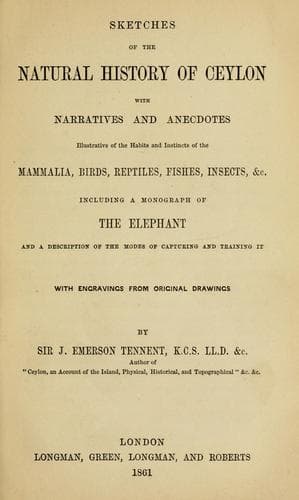
Sketches of the Natural History of CeylonTennent, James Emerson, Sir
Science
Sketches of the Natural History of Ceylon
Tennent, James Emerson, Sir
Animals -- Sri Lanka; Asiatic elephant -- Sri Lanka
As usually observed it is of a dull greenish brown, but when excited its
back becomes a rich olive green, leaving the head yellowish: the
underside of the body is of a very pale blue, almost approaching white.
The open mouth exhibits the fauces of an intense vermilion tint; so
that, although extremely handsome, this lizard presents, from its
extraordinarily shaped head and threatening gestures, a most malignant
aspect. It is, however, perfectly harmless.
_Chameleon_.--The true chameleon[1] is found, but not in great numbers,
in the dry districts to the north of Ceylon, where it frequents the
trees, in slow pursuit of its insect prey; but compensated for the
sluggishness of its other movements, by the electric rapidity of its
extensible tongue. Apparently sluggish in its general habits, the
chameleon rests motionless on a branch, from which its varied hues
render it scarcely distinguishable in colour; and there patiently awaits
the approach of the insects on which it feeds. Instantly on their
appearance its wonderful tongue comes into play.
[Footnote 1: Chameleo vulgaris, _Daud_.]
[Illustration: TONGUE OF CHAMELEON.]
Though ordinarily concealed, it is capable of protrusion till it exceeds
in length the whole body of the creature. No sooner does an incautious
fly venture within reach than the extremity of this treacherous weapon
is disclosed, broad and cuneiform, and covered with a viscid fluid; and
this, extended to its full length, is darted at its prey with an
unerring aim, and redrawn within the jaws with a rapidity that renders
the act almost invisible.[1]
[Footnote 1: Prof. RYMER JONES, art. _Reptilia_, in TODD'S _Cyclop. of
Anat_. vol. iv. pt. i. p. 292.]
Whilst the faculty of this creature to assume all the colours of the
rainbow has attracted the wonder of all ages, sufficient attention has
hardly been given to the imperfect sympathy which subsists between the
two lobes of its brain, and the two sets of nerves that permeate the
opposite sides of its frame. Hence, not only has each of the eyes an
action quite independent of the other, but one side of its body appears
to be sometimes asleep whilst the other is vigilant and active; one will
assume a green tinge whilst the opposite one is red; and it is said that
the chameleon is utterly unable to swim, from the incapacity of the
muscles of the two sides to act in concert.
_Ceratophora_.--This which till lately was an unique lizard, known by
only two specimens, one in the British Museum, and another in that of
Leyden, was ascertained by Dr. Kelaart, about five years ago, to be a
native of the higher Kandyan hills, where it is sometimes seen in the
older trees in pursuit of insect larvæ. The first specimen brought to
Europe was called _Ceratophora Stoddartii_, after the name of its
finder; and the recent discovery of several others in the National
Collection has enabled me, by the aid of Dr. A. Günther, to add some
important facts to their history.
Public-domain text, read in full here on John Shaqi.
Reviews
Reviews
No reviews yet
Be the first to share your thoughts on this work.
Elsewhere in the archive
Join the Discussion
Join the discussion
Sign in to leave a comment or review.
Sign InorCreate an account