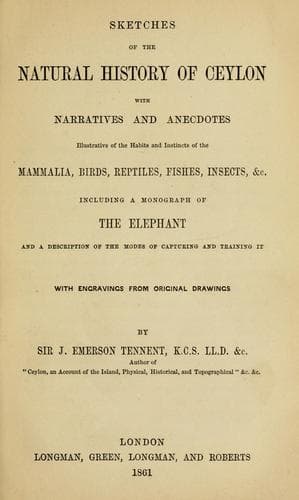
Sketches of the Natural History of CeylonTennent, James Emerson, Sir
Science
Sketches of the Natural History of Ceylon
Tennent, James Emerson, Sir
Animals -- Sri Lanka; Asiatic elephant -- Sri Lanka
[Footnote 1: The specimen in the British Museum is apparently an adult
male, ten inches long, and is, with regard to the distribution of the
scales and the form of the head very similar to _C. Stoddartii_. The
posterior angles of the orbit are not projecting, but there is a small
tubercle behind them; and a pair of somewhat larger tubercles on the
neck. The gular sac is absent. There are five longitudinal quadrangular,
imbricate scales on each side of the throat; and the sides of the body
present a nearly horizontal series of similar scales. The scales on the
median line of the back scarcely form a crest; it is, however distinct
on the nape of the neck. The scales on the belly, on the extremities,
and on the tail are slightly keeled. Tail nearly round. This species is
more uniformly coloured than _C. Stoddartii_; it is greenish, darker on
the sides.]
_Geckoes_.--The most familiar and attractive of the lizard class are the
_Geckoes_[1], that frequent the sitting-rooms, and being furnished with
pads to each toe, they are enabled to ascend perpendicular walls and
adhere to glass and ceilings. Being nocturnal in their habits, the pupil
of the eye, instead of being circular as in the diurnal species, is
linear and vertical like that of the cat. As soon as evening arrives,
the geckoes are to be seen in every house in keen and crafty pursuit of
their prey; emerging from the chinks and recesses where they conceal
themselves during the day, to search for insects that then retire to
settle for the night. In a boudoir where the ladies of my family spent
their evenings, one of these familiar and amusing little creatures had
its hiding-place behind a gilt picture frame. Punctually as the candles
were lighted, it made its appearance on the wall to be fed with its
accustomed crumbs; and if neglected, it reiterated it sharp, quick call
of _chic, chic, chit,_ till attended to. It was of a delicate gray
colour, tinged with pink; and having by accident fallen on a work-table,
it fled, leaving part of its tail behind it, which, however, it
reproduced within less than a month. This faculty of reproduction is
doubtless designed to enable the creature to escape from its assailants:
the detaching of the limb is evidently its own act; and it is
observable, that when reproduced, the tail generally exhibits some
variation from the previous form, the diverging spines being absent, the
new portion covered with small square uniform scales placed in a cross
series, and the scuta below being seldom so distinct as in the original
member.[2] In an officer's quarters in the fort of Colombo, a geckoe had
been taught to come daily to the dinner-table, and always made its
appearance along with the dessert. The family were absent for some
months, during which the house underwent extensive repairs, the roof
having been raised, the walls stuccoed, and the ceilings whitened. It
was naturally surmised that so long a suspension of its accustomed
Public-domain text, read in full here on John Shaqi.
Reviews
Reviews
No reviews yet
Be the first to share your thoughts on this work.
Elsewhere in the archive
Join the Discussion
Join the discussion
Sign in to leave a comment or review.
Sign InorCreate an account