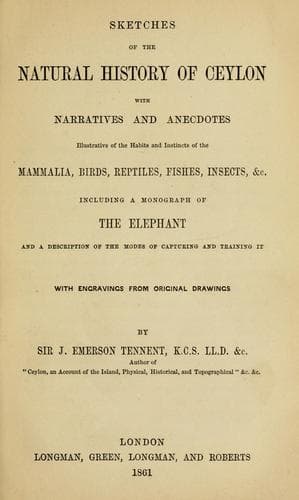
Sketches of the Natural History of CeylonTennent, James Emerson, Sir
Science
Sketches of the Natural History of Ceylon
Tennent, James Emerson, Sir
Animals -- Sri Lanka; Asiatic elephant -- Sri Lanka
habits would have led to the disappearance of the little lizard; but on
the return of its old friends, it made its entrance as usual at their
first dinner the instant the cloth was removed.
[Footnote 1: Hemidactylus maculatus, _Dum_. et _Bib_., H. Leschenaultii,
_Dum_, et _Bib_; H. frenatus, _Schlegel_. Of these the last is very
common in the houses of Colombo. Colour, grey; sides with small
granules; thumb short; chin-shields four; tail rounded with transverse
series of small spines; femoral and preanal pores in a continuous line.
GRAY, _Lizard_, p. 155.]
[Footnote 2: _Brit. Mus. Cat._ p. 143; KELAART's _Prod. Faun. Zeylan.,_
p. 183.]
_Crocodile._--The Portuguese in India, like the Spaniards in South
America, affixed the name of _lagarto_ to the huge reptiles that
infested the rivers and estuaries of both continents; and to the present
day the Europeans in Ceylon apply the term _alligator_ to what are in
reality _crocodiles_, which literally swarm in the still waters and
tanks in the low country, but rarely frequent rapid streams, and have
never been found in the marshes among the hills. The differences,
however, between the two, when once ascertained, are sufficiently
marked, to prevent their being afterwards confounded. The head of the
alligator is broader and the snout less prolonged, and the canine teeth
of the under jaw, instead of being received into foramina in the upper,
as in the crocodile, fit into furrows on each side of it. The legs of
the alligator, too, are not denticulated, and the feet are only
semi-palmate.
The following drawing exhibits a cranium of each.
[Illustration: SKULLS OF ALLIGATOR AND CROCODILE]
The instincts of the crocodiles in Ceylon do not lead to any variation
from the habits of those found in other countries. There would appear to
be two well-distinguished species found in the island, the
_Eli-kimboola_[1], the Indian crocodile, inhabiting the rivers and
estuaries throughout the low countries of the coasts, attaining the
length of sixteen or eighteen feet, and ready to assail man when pressed
by hunger; and the marsh-crocodile[2], which lives exclusively in fresh
water, frequenting the tanks in the northern and central provinces, and
confining its attacks to the smaller animals: in length it seldom
exceeds twelve or thirteen feet. Sportsmen complain that their dogs are
constantly seized by both species; and water-fowl, when shot, frequently
disappear before they can be secured by the fowler.[3] It is generally
believed in Ceylon that, in the case of larger animals, the crocodile
abstains from devouring them till the commencement of decomposition
facilitates the operation of swallowing. To assist in this, the natives
assure me that the reptile contrives to fasten the carcase behind the
roots of a mangrove or some other convenient tree and tears off each
piece by a backward spring.
[Footnote 1: Crocodilus biporcatus. _Cuvier_.]
[Footnote 2: Crododilus palustris, _Less_.]
Public-domain text, read in full here on John Shaqi.
Reviews
Reviews
No reviews yet
Be the first to share your thoughts on this work.
Elsewhere in the archive
Join the Discussion
Join the discussion
Sign in to leave a comment or review.
Sign InorCreate an account