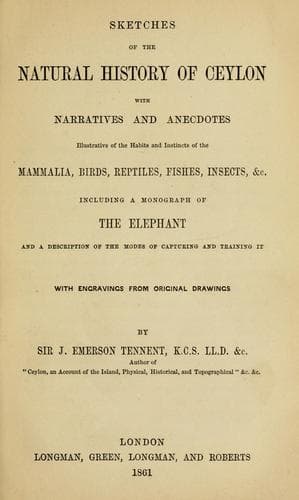
Sketches of the Natural History of CeylonTennent, James Emerson, Sir
Science
Sketches of the Natural History of Ceylon
Tennent, James Emerson, Sir
Animals -- Sri Lanka; Asiatic elephant -- Sri Lanka
[Footnote 1: Of the _Emys trijuga_, the fresh water tortoise figured on
preceding page, the technical characteristics are;--vertical plates
lozenge-shaped; shell convex and oval; with three more or less distinct
longitudinal keels; shields corrugated; with areola situated in the
upper posterior corner. Shell brown, with the areolæ and the keels
yellowish; head brown, with a yellow streak over each eye.]
The edible turtle[1] is found on all the coasts of the island, and sells
for a few shillings or a few pence, according to its size and abundance
at the moment. A very repulsive spectacle is exhibited in the markets of
Jaffna by the mode in which the flesh of the turtle is sold piece-meal,
whilst the animal is still alive, by the families of the Tamil
fishermen. The creatures are to be seen in the market-place undergoing
this frightful mutilation; the plastron and its integuments having been
previously removed, and the animal thrown on its back, so as to display
all the motions of the heart, viscera, and lungs. A broad knife, from
twelve to eighteen inches in length, is first inserted at the left side,
and the women, who are generally the operators, introduce one hand to
scoop out the blood, which oozes slowly. The blade is next passed round,
till the lower shell is detached and placed on one side, and the
internal organs exposed in full action. A customer, as he applies, is
served with any part selected, which is cut off as ordered, and sold by
weight. Each of the fins is thus successively removed, with portions of
the fat and flesh, the turtle showing, by its contortions, that each act
of severance is productive of agony. In this state it lies for hours,
writhing in the sun, the heart[2] and head being usually the last pieces
selected, and till the latter is cut off the snapping of the mouth, and
the opening and closing of the eyes, show that life is still inherent,
even when the shell has been nearly divested of its contents.
[Footnote 1: Chelonia virgata, _Schweig_.]
[Footnote 2: ARISTOTLE was aware of the fact that the turtle will live
after the removal of the heart.--_De Vita et Morte_, ch. ii.]
At certain seasons the flesh of turtle on the south-western coast of
Ceylon is avoided as poisonous, and some lamentable instances are
recorded of deaths ascribed to its use. At Pantura, to the south of
Colombo, twenty-eight persons who had partaken of turtle in October,
1840, were immediately seized with sickness, after which coma
supervened, and eighteen died during the night. Those who survived said
there was nothing unusual in the appearance of the flesh except that it
was fatter than ordinary. Other similarly fatal occurrences have been
attributed to turtle curry; but as they have never been proved to
proceed exclusively from that source, there is room for believing that
the poison may have been contained in some other ingredient.
Public-domain text, read in full here on John Shaqi.
Reviews
Reviews
No reviews yet
Be the first to share your thoughts on this work.
Elsewhere in the archive
Join the Discussion
Join the discussion
Sign in to leave a comment or review.
Sign InorCreate an account