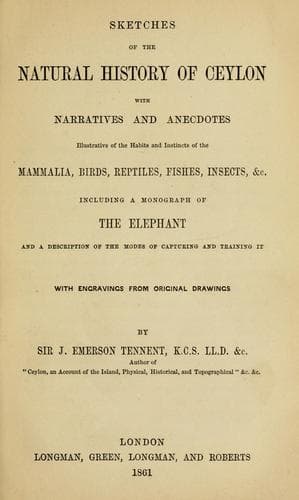
Sketches of the Natural History of CeylonTennent, James Emerson, Sir
Science
Sketches of the Natural History of Ceylon
Tennent, James Emerson, Sir
Animals -- Sri Lanka; Asiatic elephant -- Sri Lanka
In the Gulf of Manaar turtle is frequently found of such a size as to
measure between four and five feet in length; and on one occasion, in
riding along the sea-shore north of Putlam, I saw a man in charge of
some sheep, resting under the shade of a turtle shell, which he had
erected on sticks to protect him from the sun--almost verifying the
statement of Ælian, that in the seas off Ceylon there are tortoises so
large that several persons may find ample shelter beneath a single
shell.[1]
[Footnote 1: [Greek: "Tiktontai de ara en tautê tê thalattê, kai
chelônai megistai, ônper oun ta elytra orophoi ginontai kai gar esti kai
pentekaideka pêchôn en chelôneion, ôs hypoikein ouk oligous, kai tous
hêlious pyrodestatous apostegei, kai skian asmenois parechei."]--Lib.
xvi. c. 17. Ælian copied this statement literatim from MEGASTHESES,
_Indica Frag._ lix. 31. May not Megasthenes have referred to some
tradition connected with the gigantic fossilised species discovered on
the Sewalik Hills, the remains of which are now in the Museum at the
East India House?]
The hawksbill-turtle[1], which supplies the tortoise-shell of commerce,
was at former times taken in great numbers in the vicinity of
Hambangtotte during the season when they came to deposit their eggs.
This gave rise to the trade in tortoise-shell at Point de Galle, where
it is still manufactured into articles of ornament by the Moors; but the
shell they employ is almost entirely imported from the Maldives.
[Footnote 1: Caretta imbricata, _Linn._]
If taken from the animal after death and decomposition, the colour of
the shell becomes clouded and milky, and hence the cruel expedient is
resorted to of seizing the turtles as they repair to the shore to
deposit their eggs, and suspending them over fires till heat makes the
plates on the dorsal shields start from the bone of the carapace, after
which the creature is permitted to escape to the water.[1] In
illustration of the resistless influence of instinct at the period of
breeding, it may be mentioned that the identical tortoise is believed to
return again and again to the same spot, notwithstanding that at each
visit she may have to undergo a repetition of this torture. In the year
1826, a hawksbill turtle was taken near Hambangtotte, which bore a ring
attached to one of its fins that had been placed there by a Dutch
officer thirty years before, with a view to establish the fact of these
recurring visits to the same beach.[2]
[Footnote 1: At Celebes, whence the finest tortoise-shell is exported to
China, the natives kill the turtle by blows on the head, and immerse the
shell in boiling water to detach the plates. Dry heat is only resorted
to by the unskilful, who frequently destroy the tortoise-shell in the
operation--_Journal Indian Archipel_. vol. iii. p. 227, 1849.]
[Footnote 2: BENNETT'S _Ceylon, &c._, c. xxxiv.]
Public-domain text, read in full here on John Shaqi.
Reviews
Reviews
No reviews yet
Be the first to share your thoughts on this work.
Elsewhere in the archive
Join the Discussion
Join the discussion
Sign in to leave a comment or review.
Sign InorCreate an account