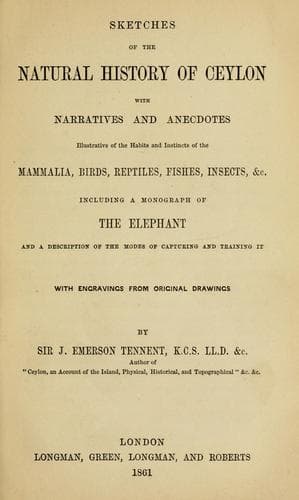
Sketches of the Natural History of CeylonTennent, James Emerson, Sir
Science
Sketches of the Natural History of Ceylon
Tennent, James Emerson, Sir
Animals -- Sri Lanka; Asiatic elephant -- Sri Lanka
_Cobra de Capello._--The cobra de capello is the only one exhibited by
the itinerant snake-charmers: and the truth of Davy's conjecture, that
they control it, not by extracting its fangs, but by courageously
availing themselves of its well-known timidity and extreme reluctance to
use its fatal weapons, received a painful confirmation during my
residence in Ceylon, by the death of one of these performers, whom his
audience had provoked to attempt some unaccustomed familiarity with the
cobra; it bit him on the wrist, and he expired the same evening. The
hill near Kandy, on which the official residences of the Governor and
Colonial Secretary are built, is covered in many places with the
deserted nests of the white ants (_termites_), and these are the
favourite retreats of the sluggish and spiritless cobra, which watches
from their apertures the toads and lizards on which it preys. Here, when
I have repeatedly come upon them, their only impulse was concealment;
and on one occasion, when a cobra of considerable length could not
escape, owing to the bank being nearly precipitous on both sides of the
road, a few blows from my whip were sufficient to deprive it of life.[1]
[Footnote 1: A Singhalese work, the _Sarpados[=a]_, enumerates four
castes of the cobra;--the _raja_, or king: the _bamunu_, or Brahman; the
_velanda_, or trader; and the _gori_, or agriculturist. Of these the
raja, or "king of the cobras," is said to have the head and the anterior
half of the body of so light a colour, that at a distance it seems like
a silvery white. The work is quoted, but not correctly, in the _Ceylon
Times_ for January, 1857. It is more than probable, as the division
represents the four castes of the Hindus, Chastriyas, Brahmans Vaisyas,
and Sudras; that the insertion of the _gori_ instead of the latter was a
pious fraud of some copyist to confer rank upon the Vellales, the
agricultural caste of Ceylon.]
A gentleman who held a civil appointment at Kornegalle, had a servant
who was bitten by a snake and he informed me that on enlarging a hole
near the foot of the tree under which the accident occurred, he
unearthed a cobra of upwards of three feet long, and so purely white as
to induce him to believe that it was an albino. With the exception of
the _rat-snake_[1], the cobra de capello is the only serpent which seems
from choice to frequent the vicinity of human dwellings, doubtless
attracted by the young of the domestic fowl and by the moisture of the
wells and drainage.
Public-domain text, read in full here on John Shaqi.
Reviews
Reviews
No reviews yet
Be the first to share your thoughts on this work.
Elsewhere in the archive
Join the Discussion
Join the discussion
Sign in to leave a comment or review.
Sign InorCreate an account