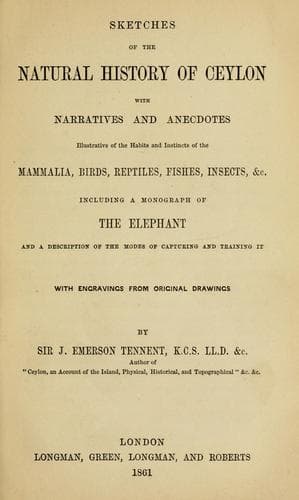
Sketches of the Natural History of CeylonTennent, James Emerson, Sir
Science
Sketches of the Natural History of Ceylon
Tennent, James Emerson, Sir
Animals -- Sri Lanka; Asiatic elephant -- Sri Lanka
Amongst the numerous pieces of folk-lore in Ceylon in connexion with
snakes, is the belief that a deadly enmity subsists between the polonga
and the cobra de capello, and that the latter, which is naturally shy
and retiring, is provoked to conflicts by the audacity of its rival.
Hence the proverb applied to persons at enmity, that "they hate like the
polonga and cobra."
The Singhalese believe the polonga to be by far the most savage and
wanton of the two, and they illustrate this by a popular legend, that
once upon a time a child, in the absence of its mother, was playing
beside a tub of water, which a cobra, impelled by thirst during a
long-continued drought, approached to drink, the unconscious child all
the while striking it with its hands to prevent the intrusion. The
cobra, on returning, was met by a tic-polonga, which seeing its scales
dripping with delicious moisture, entreated to be told the way to the
well. The cobra, knowing the vicious habits of the other snake, and
anticipating that it would kill the innocent child which it had so
recently spared, at first refused, and only yielded on condition that
the infant was not to be molested. But the polonga, on reaching the tub,
was no sooner obstructed by the little one, than it stung him to death.]
[Footnote 2: In a return of 112 coroners' inquests, in cases of death
from wild animals, held in Ceylon in five years, from 1851 to 1855
inclusive, 68 are ascribed to the bites of serpents; and in almost every
instance the assault is set down as having taken place _at night_. The
majority of the sufferers were children and women.]
[Footnote 3: PLINY notices that the serpent has the sense of hearing
more acute than that of sight; and that it is more frequently put in
motion by the sound of footsteps than by the appearance of the intruder,
"excitatur pede sæpius."--Lib, viii. c. 36.]
Public-domain text, read in full here on John Shaqi.
Reviews
Reviews
No reviews yet
Be the first to share your thoughts on this work.
Elsewhere in the archive
Join the Discussion
Join the discussion
Sign in to leave a comment or review.
Sign InorCreate an account