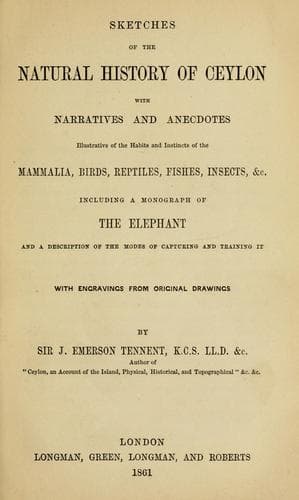
Sketches of the Natural History of CeylonTennent, James Emerson, Sir
Science
Sketches of the Natural History of Ceylon
Tennent, James Emerson, Sir
Animals -- Sri Lanka; Asiatic elephant -- Sri Lanka
[Footnote 2: The _Uropeltis grandis_ of Kelaart, which was at first
supposed to be a new species, proves to be identical with _U.
Phillippinus_ of Cuvier. It is doubtful, however, whether this species
be found in the Phillippine Islands, as stated by Cuvier; and it is more
than, probable that the typical specimen came from Ceylon--a further
illustration of the affinity of the fauna of Ceylon to that of the
Eastern Archipelago. The characteristics of this reptile, as given by
Dr. GRAY, are as follows:--"Caudal disc subcircular, with large
scattered tubercles; snout subacute, slightly produced. Dark brown,
lighter below, with some of the scales dark brown in the centre near the
posterior edge. GRAY, _Proceed. Zool. Soc._ 1858, p. 262.]
The Singhalese Buddhists, in their religious abstinence from inflicting
death on any creature, are accustomed, after securing a venomous snake,
to enclose it in a basket woven of palm leaves, and to set it afloat on
a river.
_The Python._--The great python[1] (the "boa," as it is commonly
designated by Europeans, the "anaconda" of Eastern story), which is
supposed to crush the bones of an elephant, and to swallow the tiger, is
found, though not of such portentous dimensions, in the cinnamon gardens
within a mile of the fort of Colombo, where it feeds on hog-deer, and
other smaller animals.
[Footnote 1: Python reticulatus, _Gray_.]
The natives occasionally take it alive, and securing it to a pole expose
it for sale as a curiosity. One that was brought to me tied in this way
measured seventeen feet with a proportionate thickness: but one more
fully grown, which crossed my path on a coffee estate on the Peacock
Mountain at Pusilawa, considerably exceeded these dimensions. Another
which I watched in the garden at Elie House, near Colombo, surprised me
by the ease with which it erected itself almost perpendicularly in order
to scale a wall upwards of ten feet high.
The Singhalese assert that when it has swallowed a deer, or any animal
of similarly inconvenient bulk, the python draws itself through the
narrow aperture between two trees, in order to crush the bones and
assist in the process of deglutition.
It is a singular fact that the small and innocuous ground-snakes called
_Calamariæ_, which abound on the continent of India and in the islands
are not to be found in Ceylon; where they would appear to be replaced by
two singular genera, the _Aspidura_ and _Haplocercus_, These latter have
only one series of shields below the tail, whilst most other harmless
snakes (_Calamaria_ included) have a double series of sub-candals. The
_Aspidura_ has been known to naturalists for many years[1]; the
_Haplocercus_ of Ceylon has only recently been described by Dr. Günther,
and of it not more than three existing specimens are known: hence its
habits and the extent of its distribution over the island are still left
in uncertainty.[2]
[Footnote 1: Boie in Isis 1827 p. 517.]
Public-domain text, read in full here on John Shaqi.
Reviews
Reviews
No reviews yet
Be the first to share your thoughts on this work.
Elsewhere in the archive
Join the Discussion
Join the discussion
Sign in to leave a comment or review.
Sign InorCreate an account