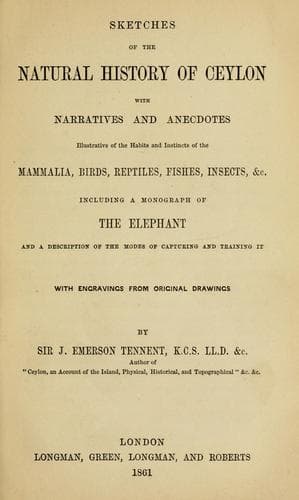
Sketches of the Natural History of CeylonTennent, James Emerson, Sir
Science
Sketches of the Natural History of Ceylon
Tennent, James Emerson, Sir
Animals -- Sri Lanka; Asiatic elephant -- Sri Lanka
[Footnote 2: GÜNTH. _Col. Snakes_, p. 14. In the hope that some inquirer
in Ceylon will be able to furnish such information as may fill up this
blank in the history of the haplocercus, the following particulars are
here appended. The largest of the specimens in the British Museum is
about twenty-five inches in length; the body thin, and much elongated;
the head narrow, and not distinct from the neck, the tail of moderate
length. Forehead covered by three shields, one anterior and two
posterior frontals; no loreal shield; one small shield before, two
behind the eye; seven shields along the upper lip, the eye being above
the fourth. The scales are disposed in seventeen longitudinal series;
they are lanceolate and strongly keeled. The upper parts are uniform
blackish or brown, with two dorsal rows of small indistinct black spots;
occiput with a whitish collar, edged with darker. The lower parts
uniform yellowish.]
Of ten species of snakes that ascend trees in Ceylon to search for
squirrels and lizards, and to rifle the nests of birds, one half,
including the green _carawala_, and the deadly _tic polonga_, are
believed by the natives to be venomous; but the truth of this is very
dubious. I have heard of the cobra being found on the crown of a
coco-nut palm, attracted, it was said, by the toddy which was flowing at
the time, it being the season for drawing it. Surrounding Elie House,
near Colombo, in which I resided, were a number of tall _casuarinas_ and
India-rubber trees, whose branches almost touched the lattices of the
window of the room in which I usually sat. These were a favourite resort
of the tree-snakes, and in the early morning the numbers which clung to
them were sometimes quite remarkable. I had thus an opportunity of
observing the action of these creatures, which seems to me one of
vigilance rather than of effort, the tongue being in perpetual activity,
as if it were an organ of feeling; and in those in which the nose is
elongated, a similar mobility and restlessness, especially when alarmed,
affords evidence of the same faculty.
Public-domain text, read in full here on John Shaqi.
Reviews
Reviews
No reviews yet
Be the first to share your thoughts on this work.
Elsewhere in the archive
Join the Discussion
Join the discussion
Sign in to leave a comment or review.
Sign InorCreate an account