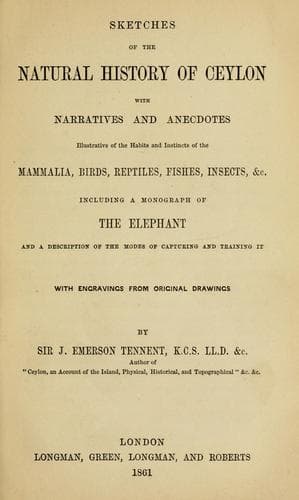
Sketches of the Natural History of CeylonTennent, James Emerson, Sir
Science
Sketches of the Natural History of Ceylon
Tennent, James Emerson, Sir
Animals -- Sri Lanka; Asiatic elephant -- Sri Lanka
The inference is obvious, that the green coloration of the majority of
tree-snakes has more or less connection with their habits and mode of
life. Indeed, whenever a green-coloured snake is observed, it may at
once be pronounced, if slender or provided with a prehensile tail, to be
of the kind which passes its life on trees; but if it be short-bodied
then it lives on the prairies. There are nevertheless tree-snakes which
have a very different coloration; and one of the most remarkable species
is the _Passerita fusca_ or _Dryinus fuscus_, of which a figure is
annexed. It closely resembles the green Passerita in form, so that
naturalists have considered it to be a mere variety. It is entirely of a
shining brown, shot with purple, and the yellow longitudinal stripe
which runs along the side of the belly of the green species, is absent
in this one. It is much more rare than the green one, and does not
appear to be found in Hindostan: no intermediate forms have been
observed in Ceylon.
_Water-Snakes._--The fresh-water snakes, of which several species[1]
inhabit the still waters and pools, are all harmless in Ceylon. A
gentleman, who found near a river an agglutinated cluster of the eggs of
one variety (_Tropidophis schistosus_), placed them under a glass shade
on his drawing-room table, where one by one the young reptiles emerged
from the shell to the number of twenty.
[Footnote 1: Chersydrus granulatus, _Merr_.; Cerberus cinereus. _Daud._;
Tropidophis schistosus, _Daud._]
The _sea-snakes_ of the Indian tropics did not escape the notice of the
early Greek mariners who navigated those seas; and amongst the facts
collected by them, Ælian has briefly recorded that the Indian Ocean
produces serpents _with flattened tails_[1], whose bite, he adds, is to
be dreaded less for its venom than the laceration of its teeth. The
first statement is accurate, but the latter is incorrect, as there is an
all but unanimous concurrence of opinion that every species of this
family of serpents is more or less poisonous. The compression of the
tail noticed by Ælian is one of the principal characteristics of these
reptiles, as their motion through the water is mainly effected by its
aid, coupled with the undulating movement of the rest of the body. Their
scales, instead of being imbricated like those of land-snakes, form
hexagons; and those on the belly, instead of being scutate and enlarged,
are nearly of the same size and form as on other parts of the body.
[Footnote 1: "[Greek: Plateis tas ouras]." ÆLIAN, L. xvi. c. 8.
Ælian speaks elsewhere of fresh-water snakes. His remark on the
compression of the tail shows that his informants were aware of this
speciality in those that inhabit the sea.]
Public-domain text, read in full here on John Shaqi.
Reviews
Reviews
No reviews yet
Be the first to share your thoughts on this work.
Elsewhere in the archive
Join the Discussion
Join the discussion
Sign in to leave a comment or review.
Sign InorCreate an account