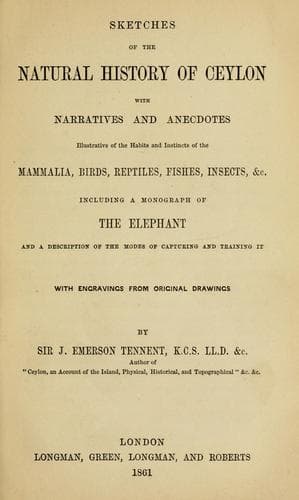
Sketches of the Natural History of CeylonTennent, James Emerson, Sir
Science
Sketches of the Natural History of Ceylon
Tennent, James Emerson, Sir
Animals -- Sri Lanka; Asiatic elephant -- Sri Lanka
The general characteristic of the Tree-snake is an exceedingly thin and
delicate body, often adorned with colours exquisite as those of the
foliage amongst which they live concealed. In some of the South American
species the tints vie in brilliancy with those of the humming-birds;
whilst their forms are so flexible and slender as to justify the name
conferred on them of "_whip-snakes_." The Siamese, to denote these
combinations of grace and splendour, call them "Sun-beams." A
naturalist[1], describing a bright green species in Brazil (_Philodryas
viridissimus_), writes: "I am always delighted when I find that another
tree-snake has settled in my garden. You look for a bird's nest, the
young ones have gone, but you find their bed occupied by one of these
beautiful creatures, which will coil up its body of two feet in length
within a space no larger than the hollow of your hand. They appear to be
always watchful; for at the instant you discover one, the quick playing
of the long, black, forked tongue will show you that you too are
observed. On perceiving the slightest sign of your intention to disturb
it, the snake will dart upwards through the branches and over the leaves
which scarcely appear to bend beneath the weight. A moment more, and you
have lost sight of it. Whenever I return to Europe, you may be sure that
in my hot-house those harmless, lovely creatures shall not be missing."
[Footnote 1: Dr. WUCHERER of Bahia.]
[Illustration: TREE SNAKE. Passerita fusca.]
Ceylon has several species of Tree-snakes, and one of the most common is
the green _Passerita_, easily recognized from its bright colour and from
the pointed moveable appendage, into which the snout is prolonged. The
snakes of this genus being active chiefly during the night, the pupil of
the eye is linear and horizontal. They never willingly descend from
trees, but prey there upon nocturnal Saurians, geckoes, small birds and
their young; and they are perfectly harmless, although they often try to
bite. It is strange that none of the numerous specimens which it has
been attempted to bring to Europe have ever fed in captivity; whilst in
South America they take their food freely in confinement, provided that
some green plants are placed in their cage.
In Ceylon I have never seen any specimen of a larger size than three
feet; whilst they are known to attain to more than five on the Indian
Continent.
Public-domain text, read in full here on John Shaqi.
Reviews
Reviews
No reviews yet
Be the first to share your thoughts on this work.
Elsewhere in the archive
Join the Discussion
Join the discussion
Sign in to leave a comment or review.
Sign InorCreate an account