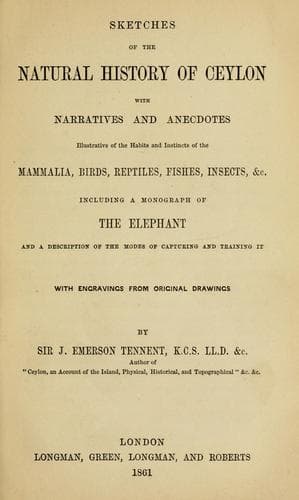
Sketches of the Natural History of CeylonTennent, James Emerson, Sir
Science
Sketches of the Natural History of Ceylon
Tennent, James Emerson, Sir
Animals -- Sri Lanka; Asiatic elephant -- Sri Lanka
the ocean, and which in an adult state, approach the beach only
occasionally, and for very short times, the tail, which is rounded and
tapering in the others, is compressed into a vertical rudder-like organ,
similar to, and answering all the purposes of, the caudal fin in a fish.
When these snakes are brought on shore or on the deck of a ship, they
are helpless and struggle vainly in awkward attitudes. Their food
consists exclusively of such fishes as are found near the surface; a
fact which affords ample proof that they do not descend to great depths,
although they can dive as well as swim. They are often found in groups
during calm weather, sleeping on the sea; but owing to their extreme
caution and shyness, attempts to catch them are rarely successful; on
the least alarm, they suddenly expel the air from their lungs and
descend below the surface; a long stream of rising air-bubbles marking
the rapid course which they make below. Their poisonous nature has been
questioned; but the presence of a strong perforated tooth and of a
venomous gland sufficiently attest their dangerous powers, even if these
had not been demonstrated by the effects of their bite. But fortunately
for the fishermen, who sometimes find them unexpectedly among the
contents of their nets, sea-snakes are unable, like other venomous
serpents, to open the jaws widely, and in reality they rarely inflict a
wound. Dr. Cantor believes, that, they are blinded by the light when
removed from their own element; and he adds that they become sluggish
and speedily die.[2]
[Footnote 1: Proc. Zool. Soc. 1858.]
[Footnote 2: _Catal. Mal. Rept_. p. 136.]
[Illustration: SEA SNAKE Hydrophis subloevis]
Those found near the coasts of Ceylon are generally small,--from one to
three feet in length, and apparently immature; and it is certain that
the largest specimens taken in the Pacific do not attain to greater
length than eight feet. In colour they are generally of a greenish
brown, in parts inclining to yellow, with occasionally cross bands of
black. The species figured in the accompanying drawing is the _Hydrophis
subloevis_ of Gray; or _Hydrus cyanocinctus_ of Boie.[1] The specimen
from which the drawing is taken, was obtained by Dr. Templeton at
Colombo.
[Footnote 1: Its technical characteristics are as follows,--Body rather
slender; ground colour yellowish with irregular black rings. Scales
nearly smooth; ventral plates broad, six-sided, smooth, some divided
into two, by a slight central groove. Occipital shields large,
triangular, and produced, with a small central shield behind them; a
series of four large temporal shields; chin shields in two pairs; eyes
very small, over the fourth and fifth labials; one ante-and two
post-oculars; the second upper labial shield elongated.]
Public-domain text, read in full here on John Shaqi.
Reviews
Reviews
No reviews yet
Be the first to share your thoughts on this work.
Elsewhere in the archive
Join the Discussion
Join the discussion
Sign in to leave a comment or review.
Sign InorCreate an account