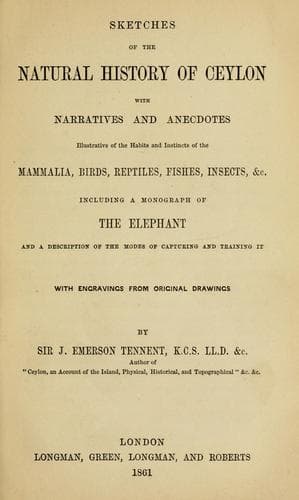
Sketches of the Natural History of CeylonTennent, James Emerson, Sir
Science
Sketches of the Natural History of Ceylon
Tennent, James Emerson, Sir
Animals -- Sri Lanka; Asiatic elephant -- Sri Lanka
[Footnote 2: The following narrative of the operations of a
snake-charmer in Ceylon is contained in a note from Mr. Reyne, of the
department of public works: "A snake-charmer came to my bungalow in
1851, requesting me to allow him to show me his snakes dancing. As I had
frequently seen them, I told him I would give him a rupee if he would
accompany me to the jungle, and catch a cobra, that I knew frequented
the place. He was willing, and as I was anxious to test the truth of the
charm, I counted his tame snakes, and put a watch over them until I
returned with him. Before going I examined the man, and satisfied myself
he had no snake about his person. When we arrived at the spot, he played
on a small pipe, and after persevering for some time out came a large
cobra from an ant hill, which I knew it occupied. On seeing the man it
tried to escape, but he caught it by the tail and kept swinging it round
until we reached the bungalow. He then made it dance, but before long it
bit him above the knee. He immediately bandaged the leg above the bite,
and applied a snake-stone to the wound to extract the poison. He was in
great pain for a few minutes, but after that it gradually went away, the
stone falling off just before he was relieved. When he recovered he held
a cloth up which the snake flew at, and caught its fangs in it; while in
that position, the man passed his hand up its back, and having seized it
by the throat, he extracted the fangs in my presence and gave them to
me. He then squeezed out the poison on to a leaf. It was a clear oily
substance, and when rubbed on the hand produced a fine lather. I
carefully watched the whole operation, which was also witnessed by my
clerk and two or three other persons. _Colombo, 13th January_
1860.--H.E. REYNE."]
[Footnote 3: Hasselquist.]
As to the snake-stone itself, I submitted one, the application of which
I have been describing, to Mr. Faraday, who has communicated to me, as
the result of his analysis, his belief that it is "a piece of charred
bone which has been filled with blood perhaps several times, and then
carefully charred again. Evidence of this is afforded, as well by the
apertures of cells or tubes on its surface as by the fact that it yields
and breaks, under pressure; and exhibits an organic structure within.
When heated slightly, water rises from it, and also a little ammonia;
and, if heated still more highly in the air, carbon burns away, and a
bulky white ash is left, retaining the shape and size of the stone."
This ash, as is evident from inspection, cannot have belonged toany
vegetable substance, for it is almost entirely composed of phosphate of
lime. Mr. Faraday adds that "if the piece of matter has ever been
employed as a spongy absorbent, it seems hardly fit for that purpose in
its present state: but who can say to what treatment it has been
subjected since it was fit for use, or to what treatment the natives may
submit it when expecting to have occasion to use it?"
Public-domain text, read in full here on John Shaqi.
Reviews
Reviews
No reviews yet
Be the first to share your thoughts on this work.
Elsewhere in the archive
Join the Discussion
Join the discussion
Sign in to leave a comment or review.
Sign InorCreate an account