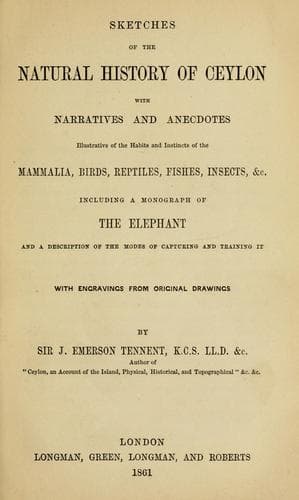
Sketches of the Natural History of CeylonTennent, James Emerson, Sir
Science
Sketches of the Natural History of Ceylon
Tennent, James Emerson, Sir
Animals -- Sri Lanka; Asiatic elephant -- Sri Lanka
The probability is, that the animal charcoal, when instantaneously
applied, may be sufficiently porous and absorbent to extract the venom
from the recent wound, together with a portion of the blood, before it
has had time to be carried into the system; and that the blood which Mr.
Faraday detected in the specimen submitted to him was that of the Indian
on whose person the effect was exhibited on the occasion to which my
informant was an eye-witness. The snake-charmers from the coast who
visit Ceylon profess to prepare the snake-stones for themselves, and to
preserve the composition a secret. Dr. Davy[1], on the authority of Sir
Alexander Johnston, says the manufacture of them is a lucrative trade,
carried on by the monks of Manilla, who supply the merchants of
India--and his analysis confirms that of Mr. Faraday. Of the three
different kinds which he examined--one being of partially burnt bone,
and another of chalk, the third, consisting chiefly of vegetable matter,
resembled bezoar,--all of them (except the first, which possessed a
slight absorbent power) were quite inert, and incapable of having any
effect except on the imagination of the patient. Thunberg was shown the
snake-stone used by the boers at the Cape in 1772, which was imported
for them "from the Indies, especially from Malabar," at so high a price
that few of the farmers could afford to possess themselves of it; he
describes it as convex on one side, black and so porous that "when
thrown into water, it caused bubbles to rise;" and hence, by its
absorbent qualities, it served, if speedily applied, to extract the
poison from the wound.[2]
[Footnote 1: _Account of the Interior of Ceylon_, ch. iii. p. 101.]
[Footnote 2: _Thunberg_, vol. i. p. 155. Since the foregoing account was
published, I have received a note from Mr. HARDY, relative to the
_piedra ponsona_, the snake-stone of Mexico, in which he gives the
following account of the method of preparing and applying it: "Take a
piece of hart's horn of any convenient size and shape; cover it well
round with grass or hay, enclose both in a thin piece of sheet copper
well wrapped round them, and place the parcel in a charcoal fire till
the bone is sufficiently charred.
"When cold, remove the calcined horn from its envelope, when it will be
ready for immediate use. In this state it will resemble a solid black
fibrous substance, of the same shape and size as before it was subjected
to this treatment.
"USE.--The wound being slightly punctured, apply the bone to the
opening, to which it will adhere firmly for the space of two minutes;
and when it falls, it should be received into a basin of water. It
should then be dried in a cloth, and again applied to the wound. But it
will not adhere longer than about one minute. In like manner it may be
applied a third time; but now it will fall almost immediately, and
nothing will cause it to adhere any more.
Public-domain text, read in full here on John Shaqi.
Reviews
Reviews
No reviews yet
Be the first to share your thoughts on this work.
Elsewhere in the archive
Join the Discussion
Join the discussion
Sign in to leave a comment or review.
Sign InorCreate an account