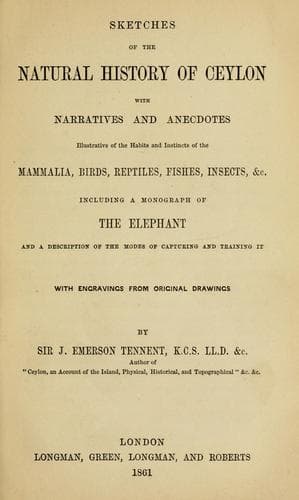
Sketches of the Natural History of CeylonTennent, James Emerson, Sir
Science
Sketches of the Natural History of Ceylon
Tennent, James Emerson, Sir
Animals -- Sri Lanka; Asiatic elephant -- Sri Lanka
In the gardens and grounds toads[1] crouch in the shade, and pursue the
flies and minute coleoptera. In Ceylon, as in Europe, these creatures
suffer from the bad renown of injecting a poison into the wound
inflicted by their bite.[2] The main calumny is confuted by the fact
that no toad has yet been discovered furnished with any teeth
whatsoever; but the obnoxious repute still attaches to the milky
exudation sometimes perceptible from glands situated on either side
behind the head; nevertheless experiments have shown, that though acrid,
the secretions of the toad are incapable of exciting more than a slight
erythema on the most delicate skins. The smell is, however, fetid and
offensive, and hence toads are less exposed to the attacks of
carnivorous animals and of birds than frogs, in which such glands do not
exist.
[Footnote 1: _Bufo melanostictus_, Schneid.]
[Footnote 2: In Ceylon this error is as old as the third century, B.C.,
when, as the _Mahawanso_ tells us, the wife of "King Asoka attempted to
destroy the great bo-tree (at Magadha) _with, the poisoned fang of a
toad._"--Ch. xx. p. 122.]
In the class of Reptiles, those only are included in the order of
Batrachians which undergo a metamorphosis before attaining maturity; and
as they offer the only example amongst Vertebrate animals of this
marvellous transformation, they are justly considered as the lowest in
the scale, with the exception of fishes, which remain during life in
that stage of development which is only the commencement of existence to
a frog.
In undergoing this change, it is chiefly the organs of respiration that
manifest alteration. In its earliest form the young batrachian, living
in the water, breathes as a fish does by _gills_, either free and
projecting as in the water-newt, or partially covered by integument as
in the tadpole. But the gills disappear as the lungs gradually become
developed: the duration of the process being on an average one hundred
days from the time the eggs were first deposited. After this important
change, the true batrachian is incapable any longer of living
continuously in water, and either betakes itself altogether to the land,
or seeks the surface from time to time to replenish its exhausted
lungs.[1]
[Footnote 1: A few Batrachians, such as the _Siren_ of Carolina, the
_Proteus_ of Illyria, the _Axolotl_ of Mexico, and the _Menobranchus_ of
the North American Lakes, retain their gills during life; but although
provided with lungs in mature age, they are not capable of living out of
the water. Such batrachians form an intermediate link between reptiles
and fishes.]
The change in the digestive functions during metamorphosis is scarcely
less extraordinary; frogs, for example, which feed on animal substances
at maturity, subsist entirely upon vegetable when in the condition of
larvæ, and the subsidiary organs undergo remarkable development, the
intestinal canal in the earlier stage being five times its length in the
later one.
Public-domain text, read in full here on John Shaqi.
Reviews
Reviews
No reviews yet
Be the first to share your thoughts on this work.
Elsewhere in the archive
Join the Discussion
Join the discussion
Sign in to leave a comment or review.
Sign InorCreate an account