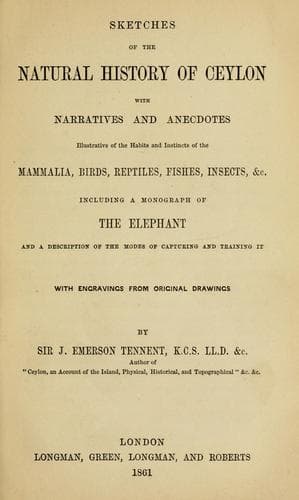
Sketches of the Natural History of CeylonTennent, James Emerson, Sir
Science
Sketches of the Natural History of Ceylon
Tennent, James Emerson, Sir
Animals -- Sri Lanka; Asiatic elephant -- Sri Lanka
"These effects I witnessed in the case of a bite of a rattle-snake at
Oposura, a town in the province of Sonora, in Mexico, from whence I
obtained my recipe; and I have given other particulars respecting it in
my Travels in the Interior of Mexico, published in 1830. R.W.H. HARDY.
_Bath_, 30_th January_, 1860."]
_Coecilia_.--The rocky jungle, bordering the higher coffee estates,
provides a safe retreat for a very singular animal, first introduced to
the notice of European naturalists about a century ago by Linnæus, who
gave it the name _Coecilia glutinosa_, to indicate two peculiarities
manifest to the ordinary observer--an apparent defect of vision, from
the eyes being so small and embedded as to be scarcely distinguishable;
and a power of secreting from minute pores in the skin a viscous fluid,
resembling that of snails, eels, and some salamanders. Specimens are
rare in Europe owing to the readiness with which it decomposes, breaking
down into a flaky mass in the spirits in which it is attempted to
preserve it.
The creature is about the length and thickness of an ordinary round desk
ruler, a little flattened before and rounded behind. It is brownish,
with a pale stripe along either side. The skin is furrowed into 350
circular folds, in which are imbedded minute scales. The head is
tolerably distinct, with a double row of fine curved teeth for seizing
the insects and worms on which it is supposed to live.
Naturalists are most desirous that the habits and metamorphoses of this
creature should be carefully ascertained, for great doubts have been
entertained as to the position it is entitled to occupy in the chain of
creation.
_Batrachians._--In the numerous marshes formed by the overflowing of the
rivers in the plains of the low country, there are many varieties of
frogs, which, both by their colours and by their extraordinary size, are
calculated to excite the surprise of a stranger. In the lakes around
Colombo and the still water near Trincomalie, there are huge creatures
of this family, from six to eight inches in length[1], of an olive hue,
deepening into brown on the back and yellow on the under side. A Kandyan
species, recently described, is of much smaller dimensions, but
distinguished by its brilliant colouring, a beautiful grass green above
and deep orange underneath[2].
[Footnote 1: A Singhalese variety of the _Rana cutipora?_ and the
Malabar bull-frog, _Hylarana Malabarica_. A frog named by BLYTH _Rana
robusta_ proves to be a Ceylon specimen of the _R. cutipora_.]
[Footnote 2: _R. Kandiana_, Kelaart.]
In the shrubberies around my house at Colombo the graceful little
tree-frogs[1] were to be found in great numbers, sheltered under broad
leaves to protect them from the scorching sun;--some of them utter a
sharp metallic sound at night, similar to that produced by smacking the
lips.
[Footnote 1: _Polypedates maculatus,_ Gray.]
Public-domain text, read in full here on John Shaqi.
Reviews
Reviews
No reviews yet
Be the first to share your thoughts on this work.
Elsewhere in the archive
Join the Discussion
Join the discussion
Sign in to leave a comment or review.
Sign InorCreate an account