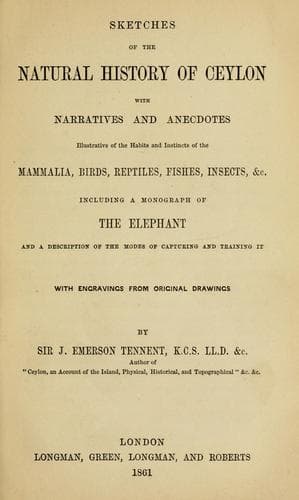
Sketches of the Natural History of CeylonTennent, James Emerson, Sir
Science
Sketches of the Natural History of Ceylon
Tennent, James Emerson, Sir
Animals -- Sri Lanka; Asiatic elephant -- Sri Lanka
NOTE.--The following species are peculiar to Ceylon (and the genera
Ceratophora, Otocryptis, Uropeltis, Aspidura. Cercaspis, and Haplocercus
would appear to be similarly restricted);--Lygosoma fallax; Trimesurus
Ceylonensis, T. nigromarginatus; Megæra Trigonocephala; Trigonocephalus
hypnalis; Daboia elegans; Rhinophis punctatus, Rh. homolepis, Rh.
planiceps, Rh. Blythii, Rh. melanogaster; Uropeltis grandis; Silybura
Ceylonica; Cylindrophis maculata; Aspidura brachyorrhos; Haplocercus
Ceylonensis; Oligodon sublineatus; Cynophis Helena; Cyclophis calamaria;
Dipsadomorphus Ceylonensis; Cercaspis carinata; Ixalus variabilis, I.
leucorhinus, I. poecilopleurus; Polypedates microtympanum. P. eques.
CHAP. X.
FISHES.
Hitherto no branch of the zoology of Ceylon has been so imperfectly
investigated as its Ichthyology. Little has been done in the examination
and description of its fishes, especially those which frequent the
rivers and inland waters. Mr. BENNETT, who was for some years employed
in the Civil Service, directed his attention to the subject, and
published in 1830 some portions of a projected work on the marine fishes
of the island[1], but it never proceeded beyond the description of
thirty individuals. The great work of Cuvier and Valenciennes[2]
particularises about one hundred species, specimens of which were
procured from Ceylon by Reynard, Leschenault and other correspondents;
but of these not more than half a dozen belong to fresh water.
[Footnote 1: _A Selection of the most Remarkable and Interesting Fishes
found on the Coast of Ceylon._ By J.W. BENNETT, Esp. London, 1830.]
[Footnote 2: _Histoire Naturelle des Poissons._]
The fishes of the coast, as far as they have been examined, present few
that are not in all probability common to the seas of Ceylon and India.
A series of drawings, including upwards of six hundred species and
varieties of Ceylon fish, all made from recently-captured specimens,
have been submitted to Professor Huxley, and a notice of their general
characteristics forms an interesting appendix to the present chapter.[1]
[Footnote 1: See note B appended to this chapter.]
Of those in ordinary use for the table the finest by far is the
Seir-fish[1], a species of Scomberoids, which is called _Tora-malu_ by
the natives. It is in size and form very similar to the salmon, to which
the flesh of the female fish, notwithstanding its white colour, bears a
very close resemblance both in firmness and flavour.
[Footnote 1: _Cybium_ (_Scomber_, Linn.) _guttatum_.]
Public-domain text, read in full here on John Shaqi.
Reviews
Reviews
No reviews yet
Be the first to share your thoughts on this work.
Elsewhere in the archive
Join the Discussion
Join the discussion
Sign in to leave a comment or review.
Sign InorCreate an account