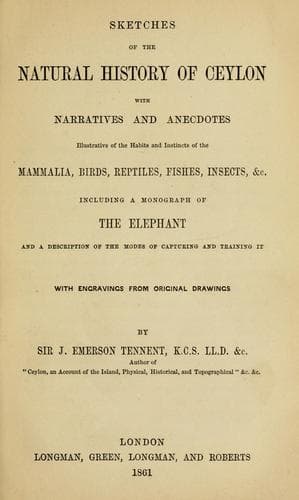
Sketches of the Natural History of CeylonTennent, James Emerson, Sir
Science
Sketches of the Natural History of Ceylon
Tennent, James Emerson, Sir
Animals -- Sri Lanka; Asiatic elephant -- Sri Lanka
Mackerel, carp, whitings, mullet both red and striped, perches and soles
are abundant, and a sardine (_Sardinella Neohowii_, Val.) frequents the
southern and eastern coast in such profusion that in one instance in
1839, a gentleman who was present saw upwards of four hundred thousand
taken in a haul of the nets in the little bay of Goyapanna, east of
Point-de-Galle. As this vast shoal approached the shore the broken water
became as smooth as if a sheet of ice had been floating below the
surface.[1]
[Footnote 1: These facts serve to explain the story told by the friar
ODORIC of Friuli, who visited Ceylon about the year 1320 A.D., and says
there are "fishes in those seas that come swimming towards the said
country in such abundance that for a great distance into the sea nothing
can be seen but the backs of fishes, which casting themselves on the
shore, do suffer men for the space of three daies to come and to take as
many of them as they please, and then they return again into the
sea."--_Hakluyt_, vol. ii. p. 57.]
_Poisonous Fishes._--The sardine has the reputation of being poisonous
at certain seasons, and accidents ascribed to eating it are recorded in
all parts of the island. Whole families of fishermen who have partaken
of it have died. Twelve persons in the jail of Chilaw were thus
poisoned, about the year 1829; and the deaths of soldiers have
repeatedly been ascribed to the same cause. It is difficult in such
instances to say with certainty whether the fish were in fault; whether
there was not a peculiar susceptibility in the condition of the
recipients; or whether the mischief may not have been occasioned by the
wilful administration of poison, or its accidental occurrence in the
brass cooking vessels used by the natives. The popular belief was,
however, deferred to by an order passed by the Governor in Council in
February, 1824, which, after reciting that "Whereas it appears by
information conveyed to the Government that at three several periods at
Trincomalie, death has been the consequence to several persons from
eating the fish called Sardinia during the months of January and
December," enacts that it shall not be lawful in that district to catch
sardines during these months, under pain of fine and imprisonment. This
order is still in force, but the fishing continues notwithstanding.[1]
[Footnote 1: There are other species of Sardine found at Ceylon besides
the _S. Neohowii_; such as the _S. lineolata_, Cuv. and Val. and the _S.
leiogaster_, Cuv. and Val. xx. 270, which was found by M. Reynaud at
Trincomalie. It occurs also off the coast of Java. Another Ceylon fish
of the same group, a Clupea, is known as the "poisonous sprat;" the
bonito (_Thynnus affinis_, Cang.), the kangewena, or unicorn fish
(_Balistes?_), and a number of others, are more or less in bad repute
from the same imputation.]
Public-domain text, read in full here on John Shaqi.
Reviews
Reviews
No reviews yet
Be the first to share your thoughts on this work.
Elsewhere in the archive
Join the Discussion
Join the discussion
Sign in to leave a comment or review.
Sign InorCreate an account