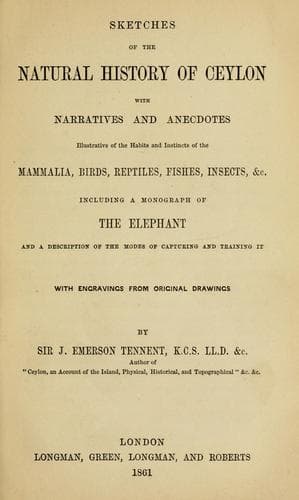
Sketches of the Natural History of CeylonTennent, James Emerson, Sir
Science
Sketches of the Natural History of Ceylon
Tennent, James Emerson, Sir
Animals -- Sri Lanka; Asiatic elephant -- Sri Lanka
Even admitting the soundness of his theory, and the probability that,
under favourable circumstances, the spawn in the tanks might be
preserved during the dry season so as to contribute to the perpetuation
of their breed, the fact is no longer doubtful, that adult fish in
Ceylon, like some of those that inhabit similar waters both in the New
and Old World, have been endowed by the Creator with the singular
faculty of providing against the periodical droughts either by
journeying overland in search of still unexhausted water, or, on its
utter disappearance, by burying themselves in the mud to await the
return of the rains.
It is an illustration of the eagerness with which, after the expedition
of Alexander the Great, particulars connected with the natural history
of India were sought for and arranged by the Greeks, that in the works
both of ARISTOTLE and THEOPHRASTUS facts are recorded of the fishes in
the Indian rivers migrating in search of water, of their burying
themselves in the mud on its failure, of their being dug out thence
alive during the dry season, and of their spontaneous reappearance on
the return of the rains. The earliest notice is in ARISTOTLE'S treatise
_De Respiratione_[1], where he mentions the strange discovery of living
fish found beneath the surface of the soil, "[Greek: tôn ichthyôn oi
polloi zôsin en tê gê, akinêtizontes mentoi, kai euriskontai
oryttomenoi?]" and in his History of Animals he conjectures that in
ponds periodically dried the ova of the fish so buried become vivified
at the change of the season.[2] HERODOTUS had previously hazarded a
similar theory to account for the sudden appearance of fry in the
Egyptian marshes on the rising of the Nile; but the cases are not
parallel. THEOPHRASTUS, the friend and pupil of Aristotle, gave
importance to the subject by devoting to it his essay [Greek: Peri tês
tôn ichthyôn en zêrô diamonês], _De Piscibus in sicco degentibus_. In
this, after adverting to the fish called _exocoetus_, from its habit of
going on shore to sleep, "[Greek: apo tês koitês,]" he instances the
small fish ([Greek: ichthydia]), that leave the rivers of India to
wander like frogs on the land; and likewise a species found near
Babylon, which, when the Euphrates runs low, leave the dry channels in
search of food, "moving themselves along by means of their fins and
tail." He proceeds to state that at Heraclea Pontica there are places in
which fish are dug out of the earth, "[Greek: oryktoi tôn ichthyôn],"
and he accounts for their being found under such circumstances by the
subsidence of the rivers, "when the water being evaporated the fish
gradually descend beneath the soil in search of moisture; and the
surface becoming hard they are preserved in the damp clay below it, in a
state of torpor, but are capable of vigorous movements when disturbed."
"In, this manner, too," adds Theophrastus, "the buried fish propagate,
leaving behind them their spawn, which becomes vivified on the return of
Public-domain text, read in full here on John Shaqi.
Reviews
Reviews
No reviews yet
Be the first to share your thoughts on this work.
Elsewhere in the archive
Join the Discussion
Join the discussion
Sign in to leave a comment or review.
Sign InorCreate an account