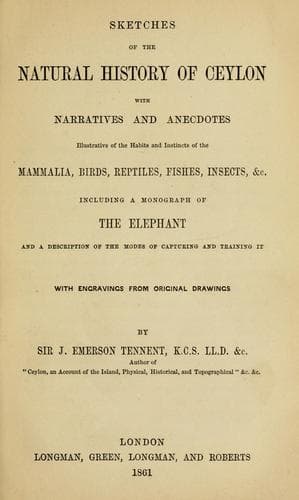
Sketches of the Natural History of CeylonTennent, James Emerson, Sir
Science
Sketches of the Natural History of Ceylon
Tennent, James Emerson, Sir
Animals -- Sri Lanka; Asiatic elephant -- Sri Lanka
the waters to their accustomed bed." This work of Theophrastus became
the great authority for all subsequent writers on this question.
ATHENÆUS quotes it[3], and adds the further testimony of POLYBIUS, that
in Gallia Narbonensis fish are similarly dug out of the ground.[4]
STRABO repeats the story[5], and the Greek naturalists one and all
received the statement as founded on reliable authority.
[Footnote 1: Chap. ix.]
[Footnote 2: Lib. vi. ch. 15, 16, 17.]
[Footnote 3: Lib. viii. ch. 2.]
[Footnote 4: _Ib._ ch. 4.]
[Footnote 5: Lib. iv. and xii.]
Not so the Romans. LIVY mentions it as one of the prodigies which were
to be "expiated" on the approach of a rupture with Macedon, that "in
Gallico agro qua induceretur aratrum sub glebis pisces emersisse,"[1]
thus taking it out of the category of natural occurrences. POMPONIUS
MELA, obliged to notice the matter in his account of Narbon Gaul,
accompanies it with the intimation that although asserted by both Greek
and Roman authorities, the story was either a delusion or a fraud,
JUVENAL has a sneer for the rustic--
"miranti sub aratro
Piscibus inventis."--_Sat_. xiii. 63.
[Footnote 1: Lib. xlii. ch. 2.]
And SENECA, whilst he quotes Theophrastus, adds ironically, that now we
must go to fish with a _hatchet_ instead of a hook; "non cum hamis, sed
cum dolabra ire piscatum." PLINY, who devotes the 35th chapter of his
9th book to this subject, uses the narrative of Theophrastus, but with
obvious caution, and universally the Latin writers treated the story as
a fable.
In later times the subject received more enlightened attention, and
Beekman, who in 1736 published his commentary on the collection [Greek:
Peri Thaumasiôn akousmatôn], ascribed to Aristotle, has given a list of
the authorities about his own times,--GEORGIUS AGRICOLA, GESNER,
RONDELET, DALECHAMP, BOMARE, and GRONOVIUS, who not only gave credence
to the assertions of Theophrastus, but adduced modern instances in
corroboration of his Indian authorities.
Public-domain text, read in full here on John Shaqi.
Reviews
Reviews
No reviews yet
Be the first to share your thoughts on this work.
Elsewhere in the archive
Join the Discussion
Join the discussion
Sign in to leave a comment or review.
Sign InorCreate an account