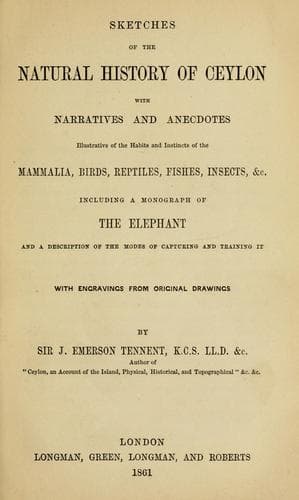
Sketches of the Natural History of CeylonTennent, James Emerson, Sir
Science
Sketches of the Natural History of Ceylon
Tennent, James Emerson, Sir
Animals -- Sri Lanka; Asiatic elephant -- Sri Lanka
Dr. John Hunter[1] has advanced an opinion that hybernation, although a
result of cold, is not its immediate consequence, but is attributable to
that deprivation of food and other essentials which extreme cold
occasions, and against the recurrence of which nature makes a timely
provision by a suspension of her functions. Excessive heat in the
tropics produces an effect upon animals and vegetables analogous to that
of excessive cold in northern regions, and hence it is reasonable to
suppose that the torpor induced by the one may be but the counterpart of
the hybernation which results from the other. The frost that imprisons
the alligator in the Mississippi as effectually cuts it off from food
and action as the drought which incarcerates the crocodile in the
sun-burnt clay of a Ceylon tank. The hedgehog of Europe enters on a
period of absolute torpidity as soon as the inclemency of winter
deprives it of its ordinary supply of slugs and insects; and the
_tenrec_[2] of Madagascar, its tropical representative, exhibits the
same tendency during the period when excessive heat produces in that
climate a like result.
[Footnote 1: HUNTER'S _Observations on parts of the Animal oeconomy_, p.
88.]
[Footnote 2: _Centetes ecaudatus_, Illiger.]
The descent of the _Ampullaria_, and other fresh-water molluscs, into
the mud of the tanks, has its parallel in the conduct of the _Bulimi_
and _Helices_ on land. The European snail, in the beginning of winter,
either buries itself in the earth or withdraws to some crevice or
overarching stone to await the returning vegetation of spring. So, in
the season of intense heat, the _Helix Waltoni_ of Ceylon, and others of
the same family, before retiring under cover, close the aperture of
their shells with an impervious epiphragm, which effectually protects
their moisture and juices from evaporation during the period of their
æstivation. The Bulimi of Chili have been found alive in England in a
box packed in cotton after an interval of two years, and the animal
inhabiting a land-shell from Suez, which was attached to a tablet and
deposited in the British Museum in 1846, was found in 1850 to have
formed a fresh epiphragm, and on being immersed in tepid water, it
emerged from its shell. It became torpid again on the 15th November,
1851, and was found dead and dried up in March, 1852.[1] But exceptions
serve to prove the accuracy of Hunter's opinion almost as strikingly as
accordances, since the same genera of animals that hybernate in Europe,
where extreme cold disarranges their oeconomy, evince no symptoms of
lethargy in the tropics, provided their food be not diminished by the
heat. Ants, which are torpid in Europe during winter, work all the year
round in India, where sustenance is uniform.[2] The shrews of Ceylon
(_Sorex montanus_ and _S. ferrugineus_ of Kelaart), like those at home,
subsist upon insects, but as they inhabit a region where the equable
temperature admits of the pursuit of their prey at all seasons of the
Public-domain text, read in full here on John Shaqi.
Reviews
Reviews
No reviews yet
Be the first to share your thoughts on this work.
Elsewhere in the archive
Join the Discussion
Join the discussion
Sign in to leave a comment or review.
Sign InorCreate an account