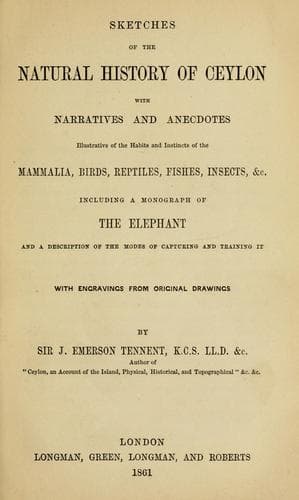
Sketches of the Natural History of CeylonTennent, James Emerson, Sir
Science
Sketches of the Natural History of Ceylon
Tennent, James Emerson, Sir
Animals -- Sri Lanka; Asiatic elephant -- Sri Lanka
year, unlike those of Europe, they never hybernate. A similar
observation applies to bats, which are dormant during a northern winter
when insects are rare, but never become torpid in any part of the
tropics. The bear, in like manner, is nowhere deprived of its activity
except when the rigour of severe frost cuts off its access to its
accustomed food. On the other hand, the tortoise, which in Venezuela
immerses itself in indurated mud during the hot months shows no tendency
to torpor in Ceylon, where its food is permanent; and yet it is subject
to hybernation when carried to the colder regions of Europe.
[Footnote 1: _Annals of Natural History_, 1860. See Dr. BAIRD'S _Account
of Helix desertorum; Excelsior,_ &c., ch. i. p. 345.]
[Footnote 2: Colonel SKYES has described in the _Entomological Trans._
the operations of an ant in India which lays up a store of hay against
the rainy season.]
To the fish in the detached tanks and pools when the heat, by exhausting
the water, deprives them at once of motion and sustenance, the practical
effect must be the same as when the frost of a northern winter encases
them in ice. Nor is it difficult to believe that they can successfully
undergo the one crisis when we know beyond question that they may
survive the other.[1]
[Footnote 1: YARRELL, vol. i. p. 364, quotes the authority of Dr. J.
Hunter in his _Animal oeconomy_, that fish, "after being frozen still
retain so much of life as when thawed to resume their vital actions;"
and in-the same volume (_Introd_. vol. i. p. xvii.) he relates from
JESSE'S _Gleanings in Natural History_, the story of a gold fish
(_Cyprinus auratus_), which, together with the a marble basin, was
frozen into one solid lump of ice, yet, on the water being thawed, the
fish became as lively as usual. Dr. RICHARDSON in the third vol of his
_Fauna Borealis Americana_, says the grey sucking carp, found in the fur
countries of North America, may be frozen and thawed again without being
killed in the process.]
_Hot-water Fishes_.--Another incident is striking in connection with the
fresh-water fishes of Ceylon. I have described elsewhere the hot springs
of Kannea[1], in the vicinity of Trincomalie, the water in which flows
at a temperature varying at different seasons from 85° to 115°. In the
stream formed by these wells M. Reynaud found and forwarded to Cuvier
two fishes which he took from the water at a time when his thermometer
indicated a temperature of 37° Reaumur, equal to 115° of Fahrenheit. The
one was an Apogon, the other an Ambassis, and to each, from the heat of
its habitat, he assigned the specific name of "thermalis."[2]
[Footnote 1: See SIR J. EMERSON TENNET's _Ceylon_, &c., vol. ii. p.
496.]
Public-domain text, read in full here on John Shaqi.
Reviews
Reviews
No reviews yet
Be the first to share your thoughts on this work.
Elsewhere in the archive
Join the Discussion
Join the discussion
Sign in to leave a comment or review.
Sign InorCreate an account