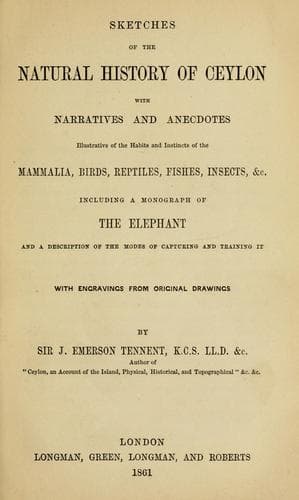
Sketches of the Natural History of CeylonTennent, James Emerson, Sir
Science
Sketches of the Natural History of Ceylon
Tennent, James Emerson, Sir
Animals -- Sri Lanka; Asiatic elephant -- Sri Lanka
The trade in shells is one of extreme antiquity in Ceylon. The Gulf of
Manaar has been fished from the earliest times for the large chank
shell, _Turbinella_ _rapa_, to be exported to India, where it is still
sawn into rings and worn as anklets and bracelets by the women of
Hindustan. Another use for these shells is their conversion into wind
instruments, which are sounded in the temples on all occasions of
ceremony. A chank, in which the whorls, instead of running from left to
right, as in the ordinary shell, are reversed, and run from right to
left, is regarded with such reverence that a specimen formerly sold for
its weight in gold, but one may now be had for four or five pounds.
COSMAS INDICO-PLEUSTES, writing in the fifth century, describes a place
on the west coast of Ceylon, which he calls Marallo, and says it
produced "[Greek: kochlious]," which THEVENOT translates "oysters;" in
which case Marallo might be conjectured to be Bentotte, near Colombo,
which yields the best edible "oysters" in Ceylon.[1] But the shell in
question was most probably the chank, and Marallo was Mantotte, off
which it is found in great numbers.[2] In fact, two centuries later
Abouzeyd, an Arab, who wrote an account of the trade and productions of
India, speaks of these shells by the name they still bear, which he
states to be _schenek_[3]; but "schenek" is not an Arabic word, and is
merely an attempt to spell the local term, _chank_, in Arabic
characters.
[Footnote 1: COSMAS INDICO-PLEUSTES, in Thevenot's ed. t i. p. 21.]
[Footnote 2: At Kottiar, near Trincomalie, I was struck with the
prodigious size of the edible oysters, which were brought to us at the
rest-house. The shell of one of these measured a little more than eleven
inches in length, by half as many broad: thus unexpectedly attesting the
correctness of one of the stories related by the historians of
Alexander's expedition, that in India they had found oysters a foot
long. PLINY says: "In Indico mari Alexandri rerum auctores pedalia
inveniri prodidere."--_Nat. Hist._ lib. xxxii. ch. 31. DARWIN says, that
amongst the fossils of Patagonia, he found "a massive gigantic oyster,
sometimes even a foot in diameter."--_Nat. Voy._, ch. viii.]
[Footnote 3:--ABOUZEYD, _Voyages Arabes,_ &c., t. i. p. 6; REINAUD,
_Mémoire sur l'Inde,_ &c p. 222.]
BERTOLACCI mentions a curious local peculiarity[1] observed by the
fishermen in the natural history of the chank. "All shells," he says,
"found to the northward of a line drawn from a point about midway from
Manaar to the opposite coast (of India) are of the kind called _patty_,
and are distinguished by a short flat head; and all those found to the
southward of that line are of the kind called _pajel_, and are known
from having a longer and more pointed head than the former. Nor is there
ever an instance of deviation from this singular law of nature. The
_Wallampory_, or 'right-hand chanks,' are found of both kinds."
Public-domain text, read in full here on John Shaqi.
Reviews
Reviews
No reviews yet
Be the first to share your thoughts on this work.
Elsewhere in the archive
Join the Discussion
Join the discussion
Sign in to leave a comment or review.
Sign InorCreate an account