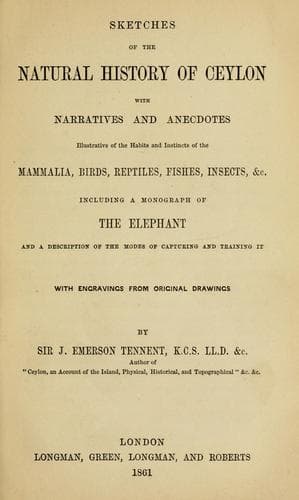
Sketches of the Natural History of CeylonTennent, James Emerson, Sir
Science
Sketches of the Natural History of Ceylon
Tennent, James Emerson, Sir
Animals -- Sri Lanka; Asiatic elephant -- Sri Lanka
[Footnote 1: See also the _Asiatic Journal for_ 1827, p. 469.]
This tendency of particular localities to re-produce certain
specialities of form and colour is not confined to the sea or to the
instance of the chank shell. In the gardens which line the suburbs of
Galle in the direction of Matura the stems of the coco-nut and jak trees
are profusely covered with the shells of the beautiful striped _Helix
hamastoma_. Stopping frequently to collect them, I was led to observe
that each separate garden seemed to possess a variety almost peculiar to
itself; in one the mouth of every individual shell was _red_; in
another, separated from the first only by a wall, _black_; and in others
(but less frequently) _pure white_; whilst the varieties of external
colouring were equally local. In one enclosure they were nearly all red,
and in an adjoining one brown.[1]
[Footnote 1: DARWIN, in his _Naturalist's Voyage_, mentions a parallel
instance of the localised propagation of colours amoungst the cattle
which range the pasturage of East Falkland Island: "Round Mount Osborne
about half of some of the herds were mouse-coloured, a tint no common
anywhere else,--near Mount Pleasant dark-brown prevailed; whereas south
of Choiseul Sound white beasts with black heads and feet were
common."--Ch. ix. p. 192.]
A trade more ancient by far than that carried on in chanks, and
infinitely more renowned, is the fishery of pearls on the west coast of
Ceylon, bordering the Gulf of Manaar. No scene in Ceylon presents so
dreary an aspect as the long sweep of desolate shore to which, from time
immemorial, adventurers have resorted from the uttermost ends of the
earth in search of the precious pearls for which this gulf is renowned.
On approaching it from sea the only perceptible landmark is a building
erected by Lord Guildford, as a temporary residence for the Governor,
and known by the name of the "Doric," from the style of its
architecture. A few coco-nut palms appear next above the low sandy
beach, and presently are discovered the scattered houses which form the
villages of Aripo and Condatchy.
Between these two places, or rather between the Kalaar and Arrive river,
the shore is raised to a height of many feet, by enormous mounds of
shells, the accumulations of ages, the millions of oysters[1], robbed of
their pearls, having been year after year flung into heaps, that extend
for a distance of many miles.
[Footnote 1: It is almost unnecessary to say that the shell fish which
produces the true Oriental pearls is not an oyster, but belongs to the
genus Avicula, or more correctly, Meleagrina. It is the _Meleagrina
Margaritifera_ of Lamarck.]
Public-domain text, read in full here on John Shaqi.
Reviews
Reviews
No reviews yet
Be the first to share your thoughts on this work.
Elsewhere in the archive
Join the Discussion
Join the discussion
Sign in to leave a comment or review.
Sign InorCreate an account