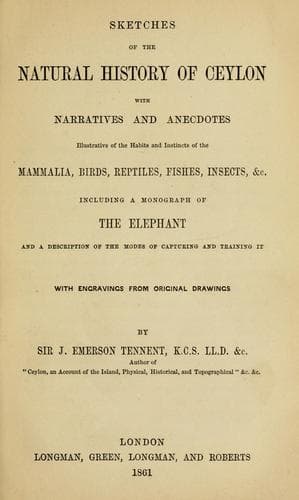
Sketches of the Natural History of CeylonTennent, James Emerson, Sir
Science
Sketches of the Natural History of Ceylon
Tennent, James Emerson, Sir
Animals -- Sri Lanka; Asiatic elephant -- Sri Lanka
On the occasion of a visit which I made to Batticaloa. in September,
1848, I made some inquiries relative to a story which had reached me of
musical sounds, said to be often heard issuing from the bottom of the
lake, at several places, both above and below the ferry opposite the old
Dutch Fort; and which the natives suppose to proceed from some fish
peculiar to the locality. The report was confirmed in all its
particulars, and one of the spots whence the sounds proceed was pointed
out between the pier and a rock that intersects the channel, two or
three hundred yards to the eastward. They were said to be heard at
night, and most distinctly when the moon was nearest the full, and they
were described as resembling the faint sweet notes of an Æolian harp. I
sent for some of the fishermen, who said they were perfectly aware of
the fact, and that their fathers had always known of the existence of
the musical sounds, heard, they said, at the spot alluded to, but only
during the dry season, as they cease when the lake is swollen by the
freshes after the rain. They believed them to proceed not from a fish,
but from a shell, which is known by the Tamil name of (_oorie cooleeroo
cradoo_, or) the "crying shell," a name in which the sound seems to have
been adopted as an echo to the sense. I sent them in search of the
shell, and they returned bringing me some living specimens of different
shells, chiefly _littorina_ and _cerithium._[1]
[Illustration: CERITHIUM PALUSTRE.]
[Footnote 1: _Littorina lævis. Cerithium palustre._ Of the latter the
specimens brought to me were dwarfed and solid, exhibiting in this
particular the usual peculiarities that distinguish (1) shells
inhabiting a rocky locality from (2) their congeners in a sandy bottom.
Their longitudinal development was less, with greater breadth, and
increased strength and weight.]
In the evening when the moon rose, I took a boat and accompanied the
fishermen to the spot. We rowed about two hundred yards north-east of
the jetty by the fort gate; there was not a breath of wind, nor a ripple
except those caused by the dip of our oars. On coming to the point
mentioned, I distinctly heard the sounds in question. They came up from
the water like the gentle thrills of a musical chord, or the faint
vibrations of a wine-glass when its rim is rubbed by a moistened finger.
It was not one sustained note, but a multitude of tiny, sounds, each
clear and distinct in itself; the sweetest treble mingling with the
lowest bass. On applying the ear to the woodwork of the boat, the
vibration was greatly increased in volume. The sounds varied
considerably at different points, as we moved across the lake, as if the
number of the animals from which they proceeded was greatest in
particular spots; and occasionally we rowed out of hearing of them
altogether, until on returning to the original locality the sounds were
at once renewed.
Public-domain text, read in full here on John Shaqi.
Reviews
Reviews
No reviews yet
Be the first to share your thoughts on this work.
Elsewhere in the archive
Join the Discussion
Join the discussion
Sign in to leave a comment or review.
Sign InorCreate an account