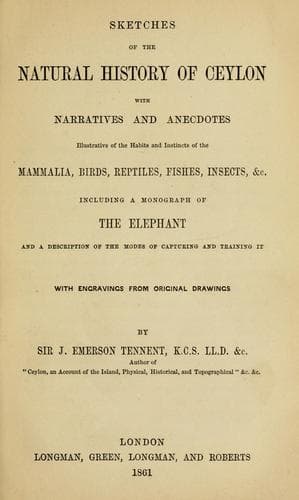
Sketches of the Natural History of CeylonTennent, James Emerson, Sir
Science
Sketches of the Natural History of Ceylon
Tennent, James Emerson, Sir
Animals -- Sri Lanka; Asiatic elephant -- Sri Lanka
This fact seems to indicate that the causes of the sounds, whatever they
may be, are stationary at several points; and this agrees with the
statement of the natives, that they are produced by mollusca, and not by
fish. They came evidently and sensibly from the depth of the lake, and
there was nothing in the surrounding circumstances to support the
conjecture that they could be the reverberation of noises made by
insects on the shore conveyed along the surface of the water; for they
were loudest and most distinct at points where the nature of the land,
and the intervention of the fort and its buildings, forbade the
possibility of this kind of conduction.
Sounds somewhat similar are heard under water at some places on the
western coast of India, especially in the harbour of Bombay.[1] At
Caldera, in Chili, musical cadences are stated to issue from the sea
near the landing-place; they are described as rising and falling fully
four notes, resembling the tones of harp strings, and mingling like
those at Batticaloa, till they produce a musical discord of great
delicacy and sweetness. The same interesting phenomenon has been
observed at the mouth of the Pascagoula, in the State of Mississippi,
and of another river called the "Bayou coq del Inde," on the northern
shore of the Gulf of Mexico. The animals from which they proceed have
not been identified at either of these places, and the mystery remains
unsolved, whether the sounds at Batticaloa are given forth by fishes or
by molluscs.
Public-domain text, read in full here on John Shaqi.
Reviews
Reviews
No reviews yet
Be the first to share your thoughts on this work.
Elsewhere in the archive
Join the Discussion
Join the discussion
Sign in to leave a comment or review.
Sign InorCreate an account