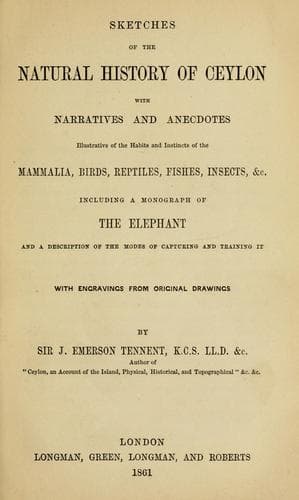
Sketches of the Natural History of CeylonTennent, James Emerson, Sir
Science
Sketches of the Natural History of Ceylon
Tennent, James Emerson, Sir
Animals -- Sri Lanka; Asiatic elephant -- Sri Lanka
[Footnote 1: The Cuckoo Gurnard (_Triglia cuculus_) and the maigre
(_Sciæna aquila_) utter sounds when taken out of the water (YARRELL,
vol. i. p. 44, 107); and herrings when the net has just been drawn have
been observed to do the same. This effect has been attributed to the
escape of air from the air bladder, but no air bladder has been found in
the _Cottus_, which makes a similar noise.]
[Footnote 2: The fishermen assert that a fish about five inches in
length, found in the lake at Colombo, and called by them "_magoora_,"
makes a grunt when disturbed under water. PALLEGOIX, in his account of
Siam, speaks of a fish resembling a sole, but of brilliant colouring
with black spots, which the natives call the "dog's tongue," that
attaches itself to the bottom of a boat, "et fait entendre un bruit
très-sonore et même harmonieux."--Tom. i. p. 194. A _Silurus_, found in
the Rio Parana, and called the "armado," is remarkable for making a
harsh grating noise when caught by hook or line, which can be distinctly
heard when the fish is beneath the water. DARWIN, _Nat. Journ._ ch. vii.
Aristotle and Ælian were aware of the existence of this faculty in some
of the fishes of the Mediterranean. ARISTOTLE, _De Anim_., lib. iv. ch.
ix.; ÆLIAN, _De Nat. Anim._, lib. x. ch. xi.; see also PLINY, lib. ix.
ch. vii.. lib. xi. ch. cxiii.; ATHENÆUS, lib. vii. ch. iii. vi. I have
heard of sounds produced under water at Baltimore, and supposed to be
produced by the "cat-fish;" and at Swan River in Australia, where they
are ascribed to the "trumpeter." A similar noise heard in the Tagus is
attributed by the Lisbon fishermen to the "_Corvina_"--but what fish is
meant by that name, I am unable to tell.]
Organs of hearing have been clearly ascertained to exist, mot only in
fishes[1], but in mollusca. In the oyster the presence of an acoustic
apparatus of the simplest possible construction has been established by
the discoveries of Siebold[2], and from our knowledge of the reciprocal
relations existing between the faculties of hearing and of producing
sounds, the ascertained existence of the one affords legitimate grounds
for inferring the coexistence of the other in animals of the same
class.[3]
[Footnote 1: AGASSIZ, _Comparative Physiology_, sec. ii. 158.]
[Footnote 2: It consists of two round vesicles containing fluid, and
crystalline or elliptical calcareous particles or otolites, remarkable
for their oscillatory action in the living or recently killed animal.
OWEN'S _Lectures on the Comparative Anatomy and Physiology of the
Invertebrate Animals_, 1855, p. 511-552.]
[Footnote 3: I am informed that Professor MÜLLER read a paper on
"Musical fishes" before the Academy of Berlin, in 1856. It will probably
be found in the volume of MÜLLER'S _Archiv. für Physiologie_ for that
year; but I have not had an opportunity of reading it.]
Public-domain text, read in full here on John Shaqi.
Reviews
Reviews
No reviews yet
Be the first to share your thoughts on this work.
Elsewhere in the archive
Join the Discussion
Join the discussion
Sign in to leave a comment or review.
Sign InorCreate an account