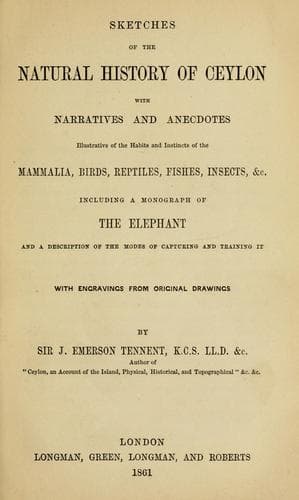
Sketches of the Natural History of CeylonTennent, James Emerson, Sir
Science
Sketches of the Natural History of Ceylon
Tennent, James Emerson, Sir
Animals -- Sri Lanka; Asiatic elephant -- Sri Lanka
Besides, it has been clearly established, that one at least of the
gasteropoda is furnished with the power of producing sounds. Dr. Grant,
in 1826, communicated to the Edinburgh Philosophical Society the fact,
that on placing some specimens of the _Tritonia arborescens_ in a glass
vessel filled with sea water, his attention was attracted by a noise
which he ascertained to proceed from these mollusca. It resembled the
"clink" of a steel wire on the side of the jar, one stroke only being
given at a time, and repeated at short intervals.[1]
[Footnote 1: _Edinburgh Philosophical Journ_., vol. xiv. p. 188. See
also the Appendix to this chapter.]
The affinity of structure between the _Tritonia_ and the mollusca
inhabiting the shells brought to me at Batticaloa, might justify the
belief of the natives of Ceylon, that the latter are the authors of the
sounds I heard; and the description of those emitted by the former as
given by Dr. Grant, so nearly resemble them, that I have always
regretted my inability, on the occasion of my visits to Batticaloa, to
investigate the subject more narrowly. At subsequent periods I have
since renewed my efforts, but without success, to obtain specimens or
observations of the habits of the living mollusca.
The only species afterwards sent to me were _Cerithia_; but no vigilance
sufficed to catch the desired sounds, and I still hesitate to accept the
dictum of the fishermen, as the same mollusc abounds in all the other
brackish estuaries on the coast; and it would be singular, if true, that
the phenomenon of its uttering a musical note should be confined to a
single spot in the lagoon of Batticaloa.[1]
[Footnote 1: The letter which I received from Dr. Grant on this subject,
I have placed in a note to the present chapter, in the hope that it may
stimulate some other inquirer in Ceylon to prosecute the investigation
which I was unable to carry out successfully.]
Although naturalists have long been familiar with the marine testacea of
Ceylon, no successful attempt has yet been made to form a classified
catalogue of the species; and I am indebted to the eminent conchologist,
Mr. Sylvanus Hanley, for the list which accompanies this notice.
In drawing it up, Mr. Hanley observes that he found it a task of more
difficulty than would at first be surmised, owing to the almost total
absence of reliable data from which to construct it. Three sources were
available: collections formed by resident naturalists, the contents of
the well-known satin-wood boxes prepared at Trincomalie, and the
laborious elimination of locality from the habitats ascribed to all the
known species in the multitude of works on conchology in general.
Public-domain text, read in full here on John Shaqi.
Reviews
Reviews
No reviews yet
Be the first to share your thoughts on this work.
Elsewhere in the archive
Join the Discussion
Join the discussion
Sign in to leave a comment or review.
Sign InorCreate an account