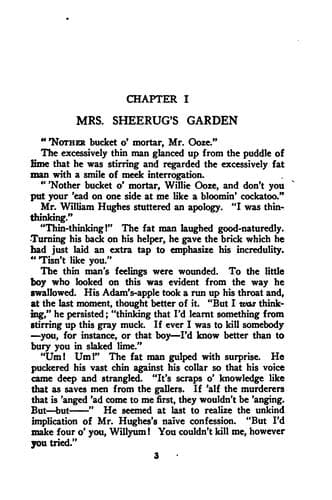
As far as Teddy could make out from their conversation, ’Enrietta had
once been Mrs. Hughes. On a trip to Southend she had insisted on taking
a swing in a highflyer. To her great annoyance her husband had been too
timid to accompany her, and she had had to take it by herself. The last
he had seen of her was a flushed face and flapping skirt swooping in
daring semi-circles between the heavens and the ground. When the swing
had stopped and he pressed through the crowd to claim her, she had
vanished.
Perhaps it was the blood on the thin man’s leg that prompted the fat
man’s observation. “It might ’ave been that.”
“What?”
The fat man drew his finger across his throat suggestively. “That.” He
repeated. “It might ’ave ’appened to your ’Enrietta.”
“Often thought it myself.” Mr. Hughes spoke slowly. “But--but d’you
think anybody would suspect that I----?”
“They might.” The fat man rubbed his chin thoughtfully. “It’s usually
chaps of your build that does it; as the lofty Mr. Shakespeare puts it,
’I ’ate those lean and ’ungry men.’”
“Very true! Very true! Lefroy was lean and ’ungry. I know, ’cause I
once rode with ’im in the same railway carriage.”
Teddy listened, fascinated and horror-stricken, to the fat and thin man
swapping anecdotes of murders past and present. For half an hour they
strove to outdo each other in ghastliness and minuteness of details.
When they had returned to their work and Mr. Hughes was at a safe
distance, the fat man spoke beneath his breath to the little boy: “He’s
no good at anything. I keep him with me ’cause we both makes a ’obby
of ’omicide--that’s the doctor’s word for the kind o’ illness we
was talking about. Also,” here his voice became as refined as Teddy’s
father’s, “he amuses me with his Cockney dialect He says he’s unlucky
because he was born in a hansom-cab. Whenever I speak to him I call him
Ooze and drop my aitches. It’s another of my hobbies--that and keeping
pigeons. Pretending to be vulgar relieves my feelings. When one’s
married and as stout as I am, if one doesn’t relieve one’s feelings one
bursts.”
For the same reason that one lavishes endearments on a dog of uncertain
temper, Teddy thought it wise to feign an interest in the fat man’s
hobbies. “It can’t be very nice for them,” he faltered.
“For ’oo?”
“The persons.”
“What persons?”
“The persons you do it to.”
“Do it to! Do it to! You’re making me lose my temper, which is bad for
me ’ealth; that’s what you’re doing. Now, then, do what? Don’t beat
about. Out with it.”
For answer the little boy drew a tremulous finger across his throat in
imitation of one of the fat man’s gestures.
The fat man started laughing--laughing uproariously. His body shook like
a jelly and fell into dimples. He tried to speak, but couldn’t. At last
he shouted: “Mr. Ooze, come ’ere. This little boy--”
Then he stopped laughing suddenly and dropped his rough way of talking.
The child’s face had gone desperately white. “Poor chap! Must have
frightened you! Here, steady.”
Public-domain text, read in full here on John Shaqi.
Reviews
Reviews
No reviews yet
Be the first to share your thoughts on this work.
Join the Discussion
Join the discussion
Sign in to leave a comment or review.
Sign InorCreate an account