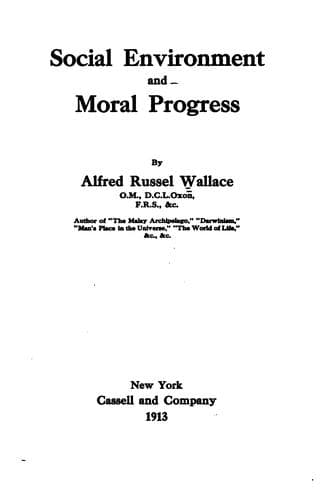
Social Environment and Moral ProgressWallace, Alfred Russel
Philosophy
Social Environment and Moral Progress
Wallace, Alfred Russel
Natural selection; Social ethics
When we remember that the Great Pyramid covers 13½ acres of ground,
that it is truly square and on a truly horizontal base, that each side
is accurately directed to a point of the compass, that the angle of its
slope is such that the area of each of the four triangular faces is
equal to that of a square whose sides are equal to the height of the
pyramid; and, further, that the slope of the long descending tunnel is
precisely such as to point accurately to the pole star of the epoch
at the lowest part of its circuit round the true pole; and, lastly,
that all this could only be done, as accurately as it has been done,
by the system of subterranean tunnels and galleries that actually
exists, while almost all the details of their construction are shown to
be adapted for astronomical observations of the nature required, the
conclusion becomes irresistible that they were designed and used for
such observations, and that by no other means could the same amount of
accuracy have been attained.
I have given a rather full account of what the Pyramid builders really
did, because it forms a very important part of the argument I am
developing as to the stationary condition of the human intellect during
the historical period.
The great majority of educated persons hold the opinion that our
wonderful discoveries and inventions in every department of art and
science prove that we are really more intellectual and wiser than
the men of past ages—that our mental faculties have increased in
power. But this idea is totally unfounded. We are the inheritors of
the accumulated knowledge of all the ages; and it is quite possible
and even probable, that the earliest steps taken in the accumulation
of this vast mental treasury required even more thought and a higher
intellectual power than any of those taken in our own era.
We can perhaps best understand this by supposing any one of our great
men of science to have been born and educated in one of the earliest
of the civilisations. If Newton had been born in Egypt in the era of
the Pyramid builders, when there were no such sciences as mathematics,
perhaps even no decimal notation which makes arithmetic so easy to
us, he could probably have done nothing more than they have actually
done. In building up the sciences each of the early steps was the work
of a genius. But now that there has been nearly a hundred centuries of
discovery and specialisation by thousands or even millions of workers,
that by means of writing and of the printing press every discovery is
quickly made known, and that ever larger and larger numbers devote
their lives to study, the rate of progress becomes quicker and quicker,
till the total result is amazingly great. But that does not prove
any superiority of the later over the earlier discoveries. There is,
therefore, no proof of continuously increasing intellectual power.
But we have now evidence of another kind, which adds to the force of
this argument.
Public-domain text, read in full here on John Shaqi.
Reviews
Reviews
No reviews yet
Be the first to share your thoughts on this work.
Join the Discussion
Join the discussion
Sign in to leave a comment or review.
Sign InorCreate an account