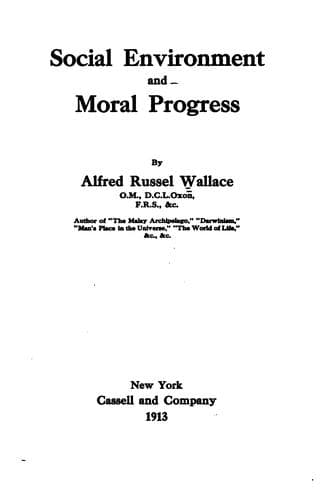
Social Environment and Moral Progress — John Shaqi
Social Environment and Moral ProgressWallace, Alfred Russel
Philosophy
Social Environment and Moral Progress
Wallace, Alfred Russel
Natural selection; Social ethics
From that time onward, during the whole of the nineteenth century,
there was a continued succession of "Factory Acts," each aiming at
abolishing or ameliorating the worst results of child labour—its
inhumanity, its cruelty, and its immorality. These legislative efforts
were always opposed by the employers, who usually succeeded in so
mutilating them in Committee of the House of Commons as to render them
almost useless. Mrs. E. B. Browning's noble verses, _The Cry of the
Children_, show that after nearly fifty years of struggle the condition
of the child-workers was still, in a high degree, cruel, degrading, and
therefore immoral; while that of the half-timers who succeeded them was
almost as injurious.
As the century wore on, other evils of a similar nature were
gradually brought to light. Children and women were found to be
working underground in coal mines, under equally vile conditions as
regards health and morality; and an enormous loss of life was caused
by inadequate ventilation, insecure roof-propping, imperfect winding
machinery, and other causes, all due to want of proper precautions by
the owners of the mines. As a matter of simple justice, such owners
should be held responsible to the injured person not only to the full
extent of his wages and for medical attendance, but should also pay a
liberal compensation for the pain suffered, and for the extra labour,
expense and anxiety to his family. But all such things are ignored
in the case of poor workers, so that even the money compensation is
reduced to the smallest amount possible.
It is one of the great defects of our law that deaths due to
preventable causes _in any profit-making business_ are not criminal
offences. Till they are made so, it will be impossible to save the
hundreds, or even thousands, of lives now lost owing to neglect of
proper precautions in all kinds of dangerous or unhealthy trades.
However costly such precautions may be, expense should not be
considered when human life is risked; and the present state of the law
is therefore immoral.
Notwithstanding Acts of Parliament and numerous Inspectors (whose
salaries should be paid by the mine owners), explosions and other
accidents underground continue to increase, the year 1910 being a
record year, with its 1,775 deaths; and even the number in proportion
to the workers employed is the highest for the last twenty years.
Yet no one is punished, or even held responsible for these deaths.
Surely, this shows a deplorable absence of moral feeling, both in the
general public and in Parliament. The responsibility of Parliament is
really criminal, since it always allows its legislation to be made
ineffective by the fear of diminishing the employers' profits, thus
deliberately placing money-making above human life and human well-being.
Public-domain text, read in full here on John Shaqi.
Reviews
Reviews
No reviews yet
Be the first to share your thoughts on this work.
Join the Discussion
Join the discussion
Sign in to leave a comment or review.
Sign InorCreate an account