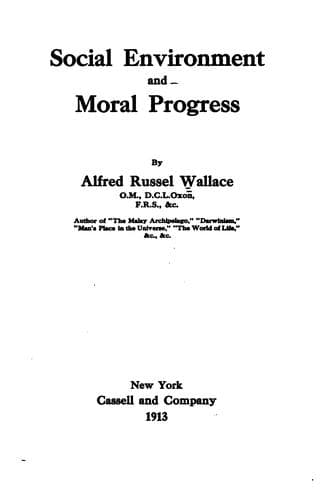
Social Environment and Moral ProgressWallace, Alfred Russel
Philosophy
Social Environment and Moral Progress
Wallace, Alfred Russel
Natural selection; Social ethics
Yet another and more serious form of plunder of the public is carried
on by means of Joint Stock Companies, of which there are now more
than 50,000 in England and Wales. In the year 1911 the number of new
companies was 5,959, while 4,353 ceased to exist, giving an increase
of 1,606 in the year. The Limited Liability Act was passed in 1855,
in order that the public might invest their savings in companies, and
thus share in the profits of our industry and commerce. It was supposed
to be quite proper that anyone should benefit by the enterprise and
industry of others; but to do so is essentially immoral, and has
resulted in a vast system of swindling and terrible losses to the
innocent investors. The promoters, directors, secretaries and bankers
of these companies always gain; those that take up the shares often
lose; and the amount of misery and absolute ruin of those who fondly
hoped to add to their scanty incomes, and have been deluded by the
names of well-known public men among the directors, is incalculable.
Our Stock Exchanges, too, are used largely for pure gambling which,
owing to its vast extent and being carried on under business forms, is
perhaps more ruinous than any other. But this form of gambling goes
on unchecked, and is generally accepted as quite honest business.
Yet ordinary betting on races and other forms of direct gambling are
hypocritically condemned as immoral and criminal.
The vast fabric of our Foreign Trade in food, or the raw materials of
our manufactures, is also used to support perhaps the greatest system
of gambling the world has ever seen. The fluctuating prices of corn or
cotton, of coal or mineral oil, of iron and other metals, in the great
markets of the world, are used in two ways by a large community of
gamblers, who not only do not require the goods they buy, but who never
see nor possess them. The ordinary speculator who buys when prices are
low, to sell again at a profit, without himself being able to influence
the rise or fall of price, is a pure gambler who thinks he can foresee
the changes of the market price in the immediate future. But the great
capitalists who, either singly or by means of what are called rings or
combines, purchase such vast quantities of the special product as to
create a scarcity in the market, leading to a large rise of price, are
ingenious robbers rather than gamblers, because, by clever dealings
with such a monopoly, often aided by false rumours widely circulated
in newspapers owned or bribed by them, they are able to make enormous
profits at the expense of those who are obliged to purchase for actual
business purposes or for daily use. This is one of the methods by which
the great millionaires and multi-millionaires of the world accumulate
their wealth, every penny of which is at the cost of the consuming
public.
Public-domain text, read in full here on John Shaqi.
Reviews
Reviews
No reviews yet
Be the first to share your thoughts on this work.
Join the Discussion
Join the discussion
Sign in to leave a comment or review.
Sign InorCreate an account