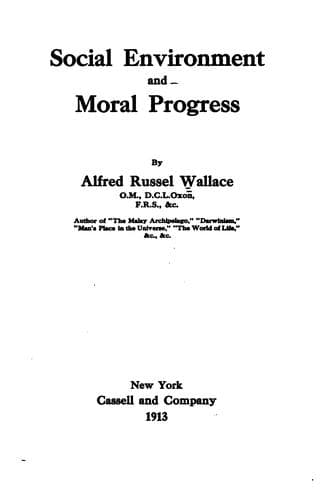
Social Environment and Moral ProgressWallace, Alfred Russel
Philosophy
Social Environment and Moral Progress
Wallace, Alfred Russel
Natural selection; Social ethics
In our criminal as well as our civil law and procedure there is equal
injustice. When the poor man is accused of the slightest offence
and brought before a magistrate by the police, he is, even though
perfectly honest and respectable, treated from the very first as if he
were guilty, often refused communication with his friends; and, when
the accusation is serious, he is remanded to prison again and again
till evidence has been hunted up, or even manufactured, against him.
Experience shows that the latter is often done and a quite innocent man
not infrequently punished. The dictum of the law, that an Englishman
should be held to be innocent till he is proved to be guilty, is
absolutely reversed, and he is treated as if he were guilty till,
against overwhelming odds, he is able to prove himself innocent. There
is no possible excuse for this now, and at the very least every man who
has a home or a permanent employment should be at once discharged on
his own recognizances.
Equally unjust and barbarous is the system of money-fines, often for
merely nominal offences, with the alternative of imprisonment. To the
well-off, or to the habitual criminal, the fine is a trifle; but to
the poor man charged with being drunk, with begging, or with sleeping
under a haystack, or any such act which is no real offence, the common
punishment of 10s. or a week's imprisonment, leaving perhaps wife and
children to starve or be sent to the workhouse, is really far more
immoral than the alleged offence.
Again, our Poor Law itself, as usually administered, is utterly
immoral. This is what a competent authority—Mr. Sidney Webb—says of
it:
"Underneath the feet of the whole wage-earning class is the
abyss of the Poor Law. I see before me a respectable family
applying for relief. What do we do to them? We, the Government
of England, break up the family. We strip each individual of
what makes life worth living. When the man enters the workhouse
he is stripped of his citizenship—branded as too infamous
to vote for a member of Parliament. Once in the workhouse,
we put him to toil or to loiter under conditions that are so
demoralising that we turn him into a wastrel. And we strip
the wife of her children. We send her to the wash-tub or
the sewing-room, where she associates with prostitutes and
imbeciles. The little children, if they are under five, are
taken to the workhouse nursery, where they also are tended by
prostitutes and imbeciles. There they remain, day after day,
without ever going down the workhouse steps until they are old
enough to go to the Poor Law school, or until they are taken
down in their coffins, owing to the terrible mortality among
the workhouse babies."
Public-domain text, read in full here on John Shaqi.
Reviews
Reviews
No reviews yet
Be the first to share your thoughts on this work.
Join the Discussion
Join the discussion
Sign in to leave a comment or review.
Sign InorCreate an account