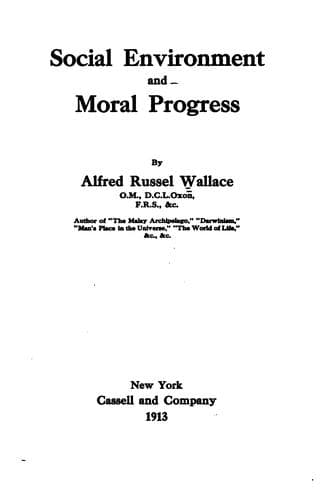
Social Environment and Moral ProgressWallace, Alfred Russel
Philosophy
Social Environment and Moral Progress
Wallace, Alfred Russel
Natural selection; Social ethics
Now, as I am credited by all my scientific friends with having
discovered the theory of natural selection more than fifty years ago,
and as the whole reading public have had this hammered into them with
needless repetition during the whole of that period, it is rather
amusing to be told now that I do not know what natural selection is,
nor what it implies. It is also a striking proof that the whole subject
is now held to be so old and commonplace as not to be worth studying by
a popular teacher before writing about it so strongly and dogmatically.
If he had done so he would not deliberately assert that I hold opinions
in regard to the matter which in several of my books I have shown the
fallacy of.
I propose, therefore, to give here a short account of the essential
features of the theory of natural selection; how it has operated in
bringing about the evolution of the almost infinitely varied forms of
plants and of the lower animals; and also to explain as clearly as I
can why, and to what extent, it has acted differently in the case of
man.
_Lamarckism and Darwinism—How they Differ_
The first great naturalist who put forward a detailed explanation of
how he supposed the varied forms of animal life to have been produced
was Lamarck, a contemporary of Buffon and Goethe, both of whom believed
in evolution but offered no explanation of how it could have been
brought about. Lamarck, however, suggested that the various organs
of animals were modified by voluntary effort producing increased
development, as when an antelope escapes from a lion by its swiftness,
which swiftness is increased by the straining of its limbs in flight;
while the long neck and fore-limbs of the giraffe were explained by the
continual stretching of these parts of the body to obtain foliage for
food during severe droughts. In addition to this other causes are at
work, as described in the following passage, translated or paraphrased
by Sir Charles Lyell in his _Principles of Geology_:
"Every considerable alteration in the local conditions under
which each race of animals exists causes a change in their
wants, and these new wants excite them to new actions and
habits. These actions require the more frequent employment of
some parts before but slightly exercised, and then greater
development follows as a consequence of their more frequent
use. Other organs, no longer in use, are impoverished and
diminished in size; nay, are sometimes entirely annihilated,
while in their place new parts are insensibly produced for the
discharge of new functions."
Again, he says:
Public-domain text, read in full here on John Shaqi.
Reviews
Reviews
No reviews yet
Be the first to share your thoughts on this work.
Join the Discussion
Join the discussion
Sign in to leave a comment or review.
Sign InorCreate an account