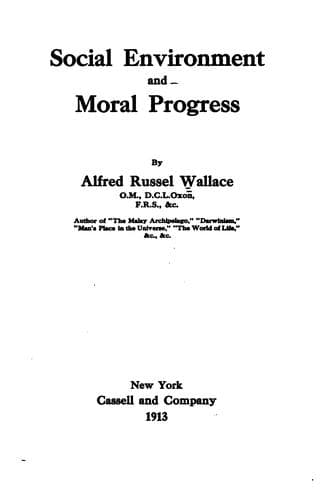
Social Environment and Moral ProgressWallace, Alfred Russel
Philosophy
Social Environment and Moral Progress
Wallace, Alfred Russel
Natural selection; Social ethics
It is necessary to point this out, because the difference between the
almost universal rejection of Lamarck's attempted solution of the
problem of evolution, and the almost immediate and universal acceptance
of that adduced by Darwin, is otherwise unexplained. The belief in the
doctrine of evolution as the only rational explanation of the gradual
development of the innumerable forms of living things became more and
more general. The great body of arguments in its favour were admirably
set forth by Robert Chambers in his _Vestiges of Creation_, published
anonymously in 1844; while Herbert Spencer's masterly exposition of
the argument for universal evolution convinced a large number of
naturalists and men of science. But still the nature of the laws and
forces by which the evolution of the organic world in all its variety
and beauty, could have been brought about remained not only unknown
but unimagined, so that even so great a thinker as Sir John Herschel
termed it "the mystery of mysteries." I will now state as briefly as
possible the essential features of Darwin's solution of the mystery in
his epoch-making work, _The Origin of Species_.
_Natural Selection as the Essential Factor in the Origin of Species_
There are two great, universal, and very conspicuous characteristics of
the whole organic world which, because they are so very common, were
almost ignored before Darwin showed their importance. These are (1) the
great _variability_ in all common and widespread species, and (2) their
enormous powers of _increase_.
Public-domain text, read in full here on John Shaqi.
Reviews
Reviews
No reviews yet
Be the first to share your thoughts on this work.
Join the Discussion
Join the discussion
Sign in to leave a comment or review.
Sign InorCreate an account