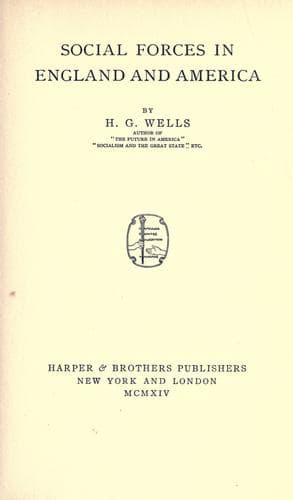
Social Forces in England and AmericaWells, H. G. (Herbert George)
History
Social Forces in England and America
Wells, H. G. (Herbert George)
England -- Social conditions -- 20th century; Social problems; United States -- Social conditions -- 1865-1918
Circumstances have made me think a good deal at different times about
the business of writing novels, and what it means, and is, and may be;
and I was a professional critic of novels long before I wrote them. I
have been writing novels, or writing about novels, for the last twenty
years. It seems only yesterday that I wrote a review—the first long and
appreciative review he had—of Mr. Joseph Conrad’s _Almayer’s Folly_ in
the _Saturday Review_. When a man has focussed so much of his life upon
the novel, it is not reasonable to expect him to take too modest or
apologetic a view of it. I consider the novel an important and necessary
thing indeed in that complicated system of uneasy adjustments and
readjustments which is modern civilisation. I make very high and wide
claims for it. In many directions I do not think we can get along
without it.
Now this, I know, is not the usually received opinion. There is, I am
aware, the theory that the novel is wholly and solely a means of
relaxation. In spite of manifest facts, that was the dominant view of
the great period that we now in our retrospective way speak of as the
Victorian, and it still survives to this day. It is the man’s theory of
the novel rather than the woman’s. One may call it the Weary Giant
theory. The reader is represented as a man, burthened, toiling, worn. He
has been in his office from ten to four, with perhaps only two hours’
interval at his club for lunch; or he has been playing golf; or he has
been waiting about and voting in the House; or he has been fishing; or
he has been disputing a point of law; or writing a sermon; or doing one
of a thousand other of the grave important things which constitute the
substance of a prosperous man’s life. Now at last comes the little
precious interval of leisure, and the Weary Giant takes up a book.
Perhaps he is vexed: he may have been bunkered, his line may have been
entangled in the trees, his favourite investment may have slumped, or
the judge have had indigestion and been extremely rude to him. He wants
to forget the troublesome realities of life. He wants to be taken out of
himself, to be cheered, consoled, amused—above all, amused. He doesn’t
want ideas, he doesn’t want facts; above all, he doesn’t
want—_Problems_. He wants to dream of the bright, thin, gay excitements
of a phantom world—in which he can be hero—of horses ridden and lace
worn and princesses rescued and won. He wants pictures of funny slums,
and entertaining paupers, and laughable longshoremen, and kindly
impulses making life sweet. He wants romance without its defiance, and
humour without its sting; and the business of the novelist, he holds, is
to supply this cooling refreshment. That is the Weary Giant theory of
the novel. It ruled British criticism up to the period of the Boer
war—and then something happened to quite a lot of us, and it has never
completely recovered its old predominance. Perhaps it will; perhaps
something else may happen to prevent its ever doing so.
Public-domain text, read in full here on John Shaqi.
Reviews
Reviews
No reviews yet
Be the first to share your thoughts on this work.
Elsewhere in the archive
Join the Discussion
Join the discussion
Sign in to leave a comment or review.
Sign InorCreate an account