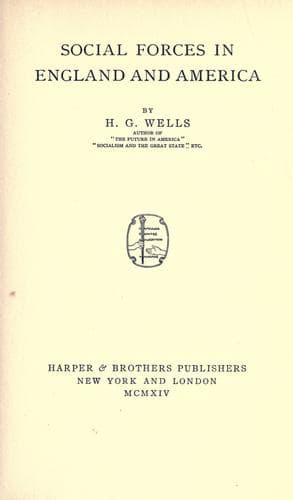
Social Forces in England and AmericaWells, H. G. (Herbert George)
History
Social Forces in England and America
Wells, H. G. (Herbert George)
England -- Social conditions -- 20th century; Social problems; United States -- Social conditions -- 1865-1918
is much, I assert, to be said for such a complete shutting up of the
family from the interference of the law, and not the least among these
reasons is the entire harmony of such a view with the passionate
instincts of the natural man and woman in these matters. All
unsophisticated human beings appear disposed to a fierce proprietorship
in their children and their sexual partners, and in no respect is the
ordinary mortal so easily induced to vehemence and violence.
For my own part, I do not think the maintenance of a marriage that is
indissoluble, that precludes the survivor from remarriage, that gives
neither party an external refuge from the misbehaviour of the other, and
makes the children the absolute property of their parents until they
grow up, would cause any very general unhappiness. Most people are
reasonable enough, good-tempered enough, and adaptable enough to shake
down even in a grip so rigid, and I would even go further and say that
its very rigidity, the entire absence of any way out at all, would
oblige innumerable people to accommodate themselves to its conditions
and make a working success of unions that, under laxer conditions, would
be almost certainly dissolved. We should have more people of what I may
call the “broken-in” type than an easier release would create, but to
many thinkers the spectacle of a human being thoroughly “broken-in” is
in itself extremely satisfactory. A few more crimes of desperation
perhaps might occur, to balance against an almost universal effort to
achieve contentment and reconciliation. We should hear more of the
“natural law” permitting murder by the jealous husband or by the jealous
wife, and the traffic in poisons would need a sedulous attention—but
even there the impossibility of remarriage would operate to restrain the
impatient. On the whole, I can imagine the world rubbing along very well
with marriage as unaccommodating as a perfected steel trap. Exceptional
people might suffer or sin wildly—to the general amusement or
indignation.
But when once we part from the idea of such a rigid and eternal marriage
bond—and the law of every civilised country and the general thought and
sentiment everywhere have long since done so—then the whole question
changes. If marriage is not so absolutely sacred a bond, if it is not an
eternal bond, but a bond we may break on this account or that, then at
once we put the question on a different footing. If we may terminate it
for adultery or cruelty, or any cause whatever, if we may suspend the
intimacy of husband and wife by separation orders and the like, if we
recognise their separate property and interfere between them and their
children to ensure the health and education of the latter, then we open
at once the whole question of a terminating agreement. Marriage ceases
to be an unlimited union and becomes a definite contract. We raise the
whole question of “What are the limits in marriage, and how and when may
a marriage terminate?”
Public-domain text, read in full here on John Shaqi.
Reviews
Reviews
No reviews yet
Be the first to share your thoughts on this work.
Elsewhere in the archive
Join the Discussion
Join the discussion
Sign in to leave a comment or review.
Sign InorCreate an account