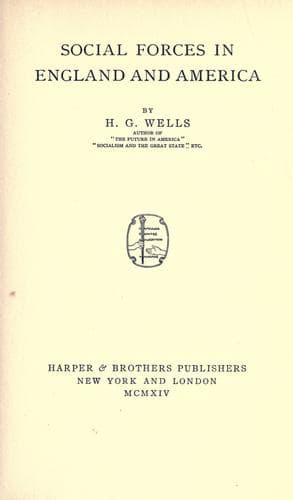
Social Forces in England and AmericaWells, H. G. (Herbert George)
History
Social Forces in England and America
Wells, H. G. (Herbert George)
England -- Social conditions -- 20th century; Social problems; United States -- Social conditions -- 1865-1918
Now, many answers are being given to that question at the present time.
We may take as the extremest opposite to the eternal marriage idea the
proposal of Mr. Bernard Shaw, that marriage should be terminable at the
instance of either party. You would give due and public notice that your
marriage was at an end, and it would be at an end. This is marriage at
its minimum, as the eternal indissoluble marriage is marriage at its
maximum, and the only conceivable next step would be to have a marriage
makeable by the oral declaration of both parties and terminable by the
oral declaration of either, which would be, indeed, no marriage at all,
but an encounter. You might marry a dozen times in that way in a day....
Somewhere between these two extremes lies the marriage law of a
civilised state. Let us, rather than working down from the eternal
marriage of the religious idealists, work up from Mr. Shaw. The former
course is, perhaps, inevitable for the legislator, but the latter is
much more convenient for our discussion.
Now, the idea of a divorce so easy and wilful as Mr. Shaw proposes
arises naturally out of an exclusive consideration of what I may call
the amorous sentimentalities of marriage. If you regard marriage as
merely the union of two people in love, then, clearly, it is
intolerable, an outrage upon human dignity, that they should remain
intimately united when either ceases to love. And in that world of Mr.
Shaw’s dreams, in which everybody is to have an equal income, and nobody
is to have children, in that culminating conversazione of humanity, his
marriage law will, no doubt, work with the most admirable results. But
if we make a step towards reality and consider a world in which incomes
are unequal, and economic difficulties abound—for the present we will
ignore the complication of offspring—we at once find it necessary to
modify the first fine simplicity of divorce at either partner’s request.
Marriage is almost always a serious economic disturbance for both man
and woman: work has to be given up and rearranged, resources have to be
pooled; only in the rarest cases does it escape becoming an indefinite
business partnership. Accordingly, the withdrawal of one partner raises
at once all sorts of questions of financial adjustment, compensation for
physical, mental, and moral damage, division of furniture and effects
and so forth. No doubt a very large part of this could be met if there
existed some sort of marriage settlement providing for the dissolution
of the partnership. Otherwise the petitioner for a Shaw-esque divorce
must be prepared for the most exhaustive and penetrating examination
before, say, a court of three assessors—representing severally the
husband, the wife, and justice—to determine the distribution of the
separation. This point, however, leads me to note in passing the need
that does exist even to-day for a more precise business supplement to
marriage as we know it in England and America. I think there ought to be
Public-domain text, read in full here on John Shaqi.
Reviews
Reviews
No reviews yet
Be the first to share your thoughts on this work.
Elsewhere in the archive
Join the Discussion
Join the discussion
Sign in to leave a comment or review.
Sign InorCreate an account